Jump to content
View in the app

A better way to browse. Learn more.

Mopar1973Man.Com LLC

A full-screen app on your home screen with push notifications, badges and more.

To install this app on iOS and iPadOS
  1. Tap the Share icon in Safari
  2. Scroll the menu and tap Add to Home Screen.
  3. Tap Add in the top-right corner.
To install this app on Android
  1. Tap the 3-dot menu (⋮) in the top-right corner of the browser.
  2. Tap Add to Home screen or Install app.
  3. Confirm by tapping Install.

Fuel psi problems

Good afternoon, I put a titanium fass lift pump along with a Fleece sureflo sending unit on my 2001 pickup about a year and a half ago. It’s been flawless for a few thousand miles. I had been noticing some slow starts when warm. Not bad just a few more revolutions than what was normal. I put some NAPA cross referenced fuel filters on because I didn’t have FASS replacements and didn’t have the time to wait . I started to take a trip recently and fuel pressure dropped significantly. I got the truck home and parked it for a month . I wasn’t real confident about the NAPA filters so i replaced with the direct replacement FASS filters. Test drove the truck for an hour or so and all seemed fine. Today it did the same thing again. I had gotten 17-19 psi at idle and 15-17 WOT. Today it dropped to 15 idle and drops significantly at WOT.

I talked to tech support at FASS and he mentioned something about a valve in the VP 44 might be a problem. Now when I turn the key on PSI jumps to 17 and drops to zero momentarily when I start the pick up. I’m in the process of putting a mechanical gauge in line to verify that the brand new auto meter pillar gauges are not the problem. Does this sound like a VP44 problem? Truck only has a 160000 miles, but I assume VP44 and everything beyond is original equipment .

Thanks, Kevin

Edited by kbf98520

  • Replies 35
  • Views 763
  • Created
  • Last Reply

Top Posters In This Topic

Most Popular Posts

  • On my truck the tee at the back of the head started to leak fuel about 15,000 miles ago (at 390,000 miles). At the time I had the transmission out while doing a clutch job and I noticed the leak. Th

  • @Tractorman Those o-rings are square cut and you would need to order from Cummins for replacement. Might be a good idea.

  • Tractorman
    Tractorman

    Give details of your bucket test. Have you ran the engine while drawing fuel from the bucket with a separate power source to the lift pump? I'm having a hard time with believing it to be a VP44 overf
Posted Images

Featured Replies

  • Author
2 hours ago, Mopar1973Man said:

Just a flag or marker there is another error. Use an actual OBDII code reader.

I had a scan gauge on a power stroke. It worked well. Can you suggest one for this pickup.

  • Author
3 hours ago, Mopar1973Man said:

Just a flag or marker there is another error. Use an actual OBDII code reader.

Can you recommend one? I’ve been meaning to get a quadzilla . Does that have code reading? Or maybe just a basic code reader for now?

Edited by kbf98520

  • Author
On 1/4/2026 at 9:45 AM, Tractorman said:

So, it sounds like the lift pump relay was not the issue? Symptoms remain the same?

  • John

That’s right, same symptoms after 100 miles or so and it seems I’m starting to get the not answer the phone/ not call back run around game on the lifetime warranty from FASS as it now seems to be an electrical issue in pump, best I can tell.

1 hour ago, Mopar1973Man said:

OBDII code reader like OBDLink MX would be a good option.

Just ordered one. Unfortunately, I have to go back to work and I won’t be able to get back on this with the code reader until February.

Edited by kbf98520

  • Author

It seemed like I might have had another bad relay , so I jumped it, pressures were all over the place, from 20 to 12psi varying rpm’s. I did another bucket test had a constant 15-16 psi for an hour. Hooked the pump back to the truck, keyed it on psi went to 20 briefly while the truck warmed up then psi was all over the place 20 to 12…. FASS is leaning heavily towards OFV in VP 44. IDK

12 hours ago, kbf98520 said:

I did another bucket test had a constant 15-16 psi for an hour. Hooked the pump back to the truck, keyed it on psi went to 20 briefly while the truck warmed up then psi was all over the place 20 to 12….

Give details of your bucket test. Have you ran the engine while drawing fuel from the bucket with a separate power source to the lift pump?

I'm having a hard time with believing it to be a VP44 overflow valve problem. Did the FASS representative explain with detail on exactly how an VP44 overflow valve problem would adversely affect lift pump pressure?

Also, if there is a restriction in the fuel supply anywhere in the lift pump circuit (especially the suction side), then unpredictable fuel pressure could be expected.

What it the GPH rating on your lift pump?

  • John

Edited by Tractorman

  • Author
2 hours ago, Tractorman said:

Give details of your bucket test. Have you ran the engine while drawing fuel from the bucket with a separate power source to the lift pump?

I'm having a hard time with believing it to be a VP44 overflow valve problem. Did the FASS representative explain with detail on exactly how an VP44 overflow valve problem would adversely affect lift pump pressure?

Also, if there is a restriction in the fuel supply anywhere in the lift pump circuit (especially the suction side), then unpredictable fuel pressure could be expected.

What it the GPH rating on your lift pump?

  • John

It’s a Titanium Series 100 hog. It was an isolated bucket test, did not run the engine from bucket.

Unfortunately I have to leave the truck for a month or so will not be able to do anything

100 GPH. Spellcheck got me

7 hours ago, kbf98520 said:

Unfortunately I have to leave the truck for a month or so will not be able to do anything

It will give you time to clear your mind and come up with a good diagnostic approach.

Possible issues to keep in mind:

  • intermittent fuel supply blockage, especially suction side of lift pump

  • large amount of air in fuel system (not likely)

  • intermittent power to lift pump

  • faulty lift pump (pressure regulator issue)

When things get difficult to diagnose for me, I change tactics and try to prove what is working CORRECTLY, not what is working INCORRECTLY - a process of elimination. This method will sometimes get the issue resolved sooner than focusing on things that one might think is wrong.

  • John

  • 1 month later...
  • Author

Ok, I’m home and back on this pickup. This morning I ran the pump with pressure feed to engine plugged to test FASS return circuit repeatedly and got a steady 17-19 psi . I’ve now done every test recommended by FASS they are again suggesting OFV failure. They explained it as dumping pressure prematurely.

I get good continuous suction and pressure with every form of bucket test I’ve done. I have not run the engine out of a bucket. I don’t see why that is needed.

Kevin

  • Author

Actually psi is about 19 initially then jumps to 22.5

  • Owner
1 hour ago, kbf98520 said:

Ok, I’m home and back on this pickup. This morning I ran the pump with pressure feed to engine plugged to test FASS return circuit repeatedly and got a steady 17-19 psi . I’ve now done every test recommended by FASS they are again suggesting OFV failure. They explained it as dumping pressure prematurely.

I get good continuous suction and pressure with every form of bucket test I’ve done. I have not run the engine out of a bucket. I don’t see why that is needed.

Kevin

That should give you all the info for testing the overflow valve on the VP44. Just remember the little hole is always open and some pressure can bleed. The check ball should stay closed completely at 10 PSI. Fully open by 14 PSI.

2 hours ago, kbf98520 said:

This morning I ran the pump with pressure feed to engine plugged to test FASS return circuit repeatedly and got a steady 17-19 psi

I am assuming that there is a return flow line to the fuel tank that is directly connected to the FASS pump. Did you measure fuel flow returning to the tank during your test while the lift pump pressure was at 17-19 psi? This is important. In all of your testing, you have mentioned various fuel pressures, but you have never mentioned flow during the test. Maybe it's flowing lots of fuel at the pressure stated, but we don't know that because you have not mentioned anything about flow.

If your return flow was low during the test, it would not necessarily condemn the lift pump - there could be a suction restriction to flow, which could show the same symptoms.

If your return flow was high and steady during the test, it would show that the lift pump is performing as it should and that there is no suction restriction (at least for the duration of the test).

An idling engine returns about 18 gph of fuel to the fuel tank through the overflow valve. The overflow valve is downstream of the VP44's internal fixed displacement vane pump. This internal vane pump's pressure is regulated at over 100 psi. All fuel must pass through this pump - there is no bypass. Even if the overflow valve offered no back pressure, the fuel return volume will remain virtually the same, consequently lift pump pressure will remain the same.

So, I am not saying that an overflow valve cannot be your problem - I am just explaining why I don't think it is your problem. And, your case will be the first one that I know of, if it turns out to be your problem. It is certainly easy enough to remove and test the overflow valve with regulated air pressure.

3 hours ago, kbf98520 said:

I get good continuous suction and pressure with every form of bucket test I’ve done. I have not run the engine out of a bucket. I don’t see why that is needed.

Here you mention fuel pressure, but not fuel flow. Fuel pressure tells you that there is a resistance to some flow, it just doesn't tell how much flow. If the flow is not enough to meet the demand of the VP44 internal vane pump, then fuel pressure will fall.

I know you will persevere.

  • John

  • Author
3 hours ago, Tractorman said:

I am assuming that there is a return flow line to the fuel tank that is directly connected to the FASS pump. Did you measure fuel flow returning to the tank during your test while the lift pump pressure was at 17-19 psi? This is important. In all of your testing, you have mentioned various fuel pressures, but you have never mentioned flow during the test. Maybe it's flowing lots of fuel at the pressure stated, but we don't know that because you have not mentioned anything about flow.

If your return flow was low during the test, it would not necessarily condemn the lift pump - there could be a suction restriction to flow, which could show the same symptoms.

If your return flow was high and steady during the test, it would show that the lift pump is performing as it should and that there is no suction restriction (at least for the duration of the test).

An idling engine returns about 18 gph of fuel to the fuel tank through the overflow valve. The overflow valve is downstream of the VP44's internal fixed displacement vane pump. This internal vane pump's pressure is regulated at over 100 psi. All fuel must pass through this pump - there is no bypass. Even if the overflow valve offered no back pressure, the fuel return volume will remain virtually the same, consequently lift pump pressure will remain the same.

So, I am not saying that an overflow valve cannot be your problem - I am just explaining why I don't think it is your problem. And, your case will be the first one that I know of, if it turns out to be your problem. It is certainly easy enough to remove and test the overflow valve with regulated air pressure.

Here you mention fuel pressure, but not fuel flow. Fuel pressure tells you that there is a resistance to some flow, it just doesn't tell how much flow. If the flow is not enough to meet the demand of the VP44 internal vane pump, then fuel pressure will fall.

I know you will persevere.

  • John

I just verified flow. Filled 1/2 a five gallon bucket in less than a minute with first the pressure side then the return side.

3 hours ago, Tractorman said:

I am assuming that there is a return flow line to the fuel tank that is directly connected to the FASS pump. Did you measure fuel flow returning to the tank during your test while the lift pump pressure was at 17-19 psi? This is important. In all of your testing, you have mentioned various fuel pressures, but you have never mentioned flow during the test. Maybe it's flowing lots of fuel at the pressure stated, but we don't know that because you have not mentioned anything about flow.

If your return flow was low during the test, it would not necessarily condemn the lift pump - there could be a suction restriction to flow, which could show the same symptoms.

If your return flow was high and steady during the test, it would show that the lift pump is performing as it should and that there is no suction restriction (at least for the duration of the test).

An idling engine returns about 18 gph of fuel to the fuel tank through the overflow valve. The overflow valve is downstream of the VP44's internal fixed displacement vane pump. This internal vane pump's pressure is regulated at over 100 psi. All fuel must pass through this pump - there is no bypass. Even if the overflow valve offered no back pressure, the fuel return volume will remain virtually the same, consequently lift pump pressure will remain the same.

So, I am not saying that an overflow valve cannot be your problem - I am just explaining why I don't think it is your problem. And, your case will be the first one that I know of, if it turns out to be your problem. It is certainly easy enough to remove and test the overflow valve with regulated air pressure.

Here you mention fuel pressure, but not fuel flow. Fuel pressure tells you that there is a resistance to some flow, it just doesn't tell how much flow. If the flow is not enough to meet the demand of the VP44 internal vane pump, then fuel pressure will fall.

I know you will persevere.

  • John

  • Tomorrow I guess I will pull OFV and test it. Are there o rings sealing the OFV?

It appears that the lift pump is doing its job. Were you able to hold a specific pressure - say, 15 psi - while you filled the bucket?

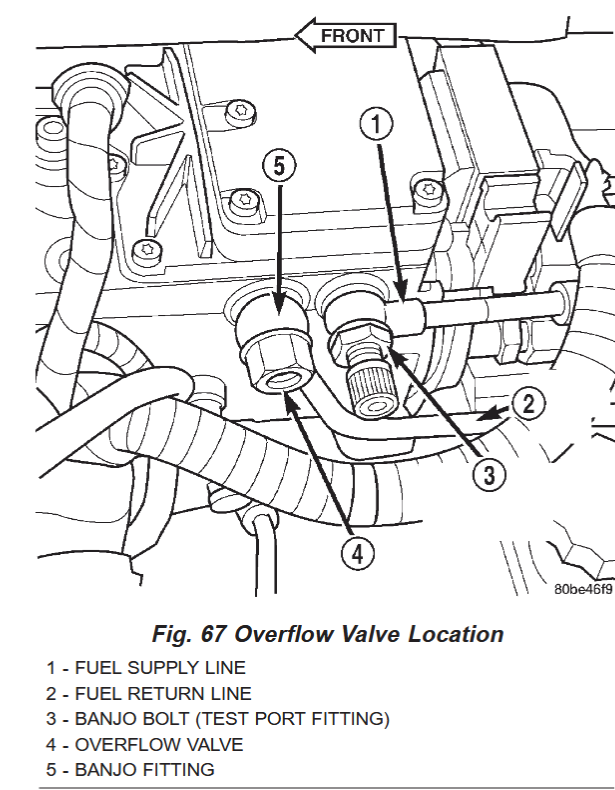
Overflow valve removal, testing, and installation from the FSM below. No o-rings, just two sealing washers at the banjo fitting. If the sealing washers appear to be okay, I would re-use them - just carefully check for leaks after reassembly.

  • John

REMOVAL, TESTING, AND INSTALLATION

The overflow valve (pressure relief valve) is located

at the outside of fuel injection pump (Fig. 67). It con-

nects the fuel return line (banjo fitting) to the pump.

The valve has no internal serviceable parts and must

be replaced as an assembly. Two sealing gaskets are

used. One gasket is located between pump and banjo

fitting. The other is located between the banjo fitting

and end of valve.

image.png

A rubber tipped blow gun with regulated air line

pressure is needed for this test.

(1) Clean area around overflow valve and fuel

return line at injection pump before removal.

(2) Remove valve from pump and banjo fitting.

(3) Discard old sealing gaskets.

(4) Set regulated air pressure to approximately 97

kPa (14–16 psi).

(5) Using blow gun, apply pressure to overflow

valve inlet end (end that goes into injection pump).

(6) Internal check valve should release, and air

should pass through valve at 97 kPa (14–16 psi). If

not, replace valve.

(7) Reduce regulated air pressure to 10 psi and

observe valve. Valve should stay shut. If not, replace

valve.

(8) Install new sealing gaskets to valve.

(9) Install valve through banjo fitting and into

pump.

(10) Tighten to 30 N·m (24 ft. lbs.) torque.

Edited by Tractorman

  • Author
32 minutes ago, Tractorman said:

It appears that the lift pump is doing its job. Were you able to hold a specific pressure - say, 15 psi - while you filled the bucket?

Overflow valve removal, testing, and installation from the FSM below. No o-rings, just two sealing washers at the banjo fitting. If the sealing washers appear to be okay, I would re-use them - just carefully check for leaks after reassembly.

  • John

32 minutes ago, Tractorman said:

Yes, 17-19 psi. Thank you for your help

Kevin

Account

Navigation

Search

Configure browser push notifications

Chrome (Android)
  1. Tap the lock icon next to the address bar.
  2. Tap Permissions → Notifications.
  3. Adjust your preference.
Chrome (Desktop)
  1. Click the padlock icon in the address bar.
  2. Select Site settings.
  3. Find Notifications and adjust your preference.