Jump to content
View in the app

A better way to browse. Learn more.

Mopar1973Man.Com LLC

A full-screen app on your home screen with push notifications, badges and more.

To install this app on iOS and iPadOS
  1. Tap the Share icon in Safari
  2. Scroll the menu and tap Add to Home Screen.
  3. Tap Add in the top-right corner.
To install this app on Android
  1. Tap the 3-dot menu (⋮) in the top-right corner of the browser.
  2. Tap Add to Home screen or Install app.
  3. Confirm by tapping Install.

Good afternoon, I put a titanium fass lift pump along with a Fleece sureflo sending unit on my 2001 pickup about a year and a half ago. It’s been flawless for a few thousand miles. I had been noticing some slow starts when warm. Not bad just a few more revolutions than what was normal. I put some NAPA cross referenced fuel filters on because I didn’t have FASS replacements and didn’t have the time to wait . I started to take a trip recently and fuel pressure dropped significantly. I got the truck home and parked it for a month . I wasn’t real confident about the NAPA filters so i replaced with the direct replacement FASS filters. Test drove the truck for an hour or so and all seemed fine. Today it did the same thing again. I had gotten 17-19 psi at idle and 15-17 WOT. Today it dropped to 15 idle and drops significantly at WOT.

I talked to tech support at FASS and he mentioned something about a valve in the VP 44 might be a problem. Now when I turn the key on PSI jumps to 17 and drops to zero momentarily when I start the pick up. I’m in the process of putting a mechanical gauge in line to verify that the brand new auto meter pillar gauges are not the problem. Does this sound like a VP44 problem? Truck only has a 160000 miles, but I assume VP44 and everything beyond is original equipment .

Thanks, Kevin

Edited by kbf98520

  • Replies 8
  • Views 96
  • Created
  • Last Reply

Top Posters In This Topic

Most Popular Posts

  • On my truck the tee at the back of the head started to leak fuel about 15,000 miles ago (at 390,000 miles). At the time I had the transmission out while doing a clutch job and I noticed the leak. Th

  • @Tractorman Those o-rings are square cut and you would need to order from Cummins for replacement. Might be a good idea.

  • I believe you're experiencing a suction side air leak. Double-check the suction line side fittings, make sure they are snug and clean in the fittings. Let me know what type of hardware you're using.

Featured Replies

  • Owner

I believe you're experiencing a suction side air leak. Double-check the suction line side fittings, make sure they are snug and clean in the fittings. Let me know what type of hardware you're using.

The other part could be that you have a return line leak? Like, possibly a crossover o-ring issue or maybe injector o-ting. Sounds weird, but I've done a head gasket after the head came back, cleaned the baked injector o-rings would weep air in, allowing the system to drain, making a hard start. I've see nthis with crossover tube o-rings as well. Make sure to double-check the return tee in the rear of the engine; it might be weeping air into the system while parked.

  • Author

Ok, the return line wouldn’t cause the low pressure while running would it

45 minutes ago, Mopar1973Man said:

I believe you're experiencing a suction side air leak. Double-check the suction line side fittings, make sure they are snug and clean in the fittings. Let me know what type of hardware you're using.

The other part could be that you have a return line leak? Like, possibly a crossover o-ring issue or maybe injector o-ting. Sounds weird, but I've done a head gasket after the head came back, cleaned the baked injector o-rings would weep air in, allowing the system to drain, making a hard start. I've see nthis with crossover tube o-rings as well. Make sure to double-check the return tee in the rear of the engine; it might be weeping air into the system while parked.

Everything is JIC and I beiieve everything downstream of VP44 is stock

1 hour ago, kbf98520 said:

I talked to tech support at FASS and he mentioned something about a valve in the VP 44 might be a problem.

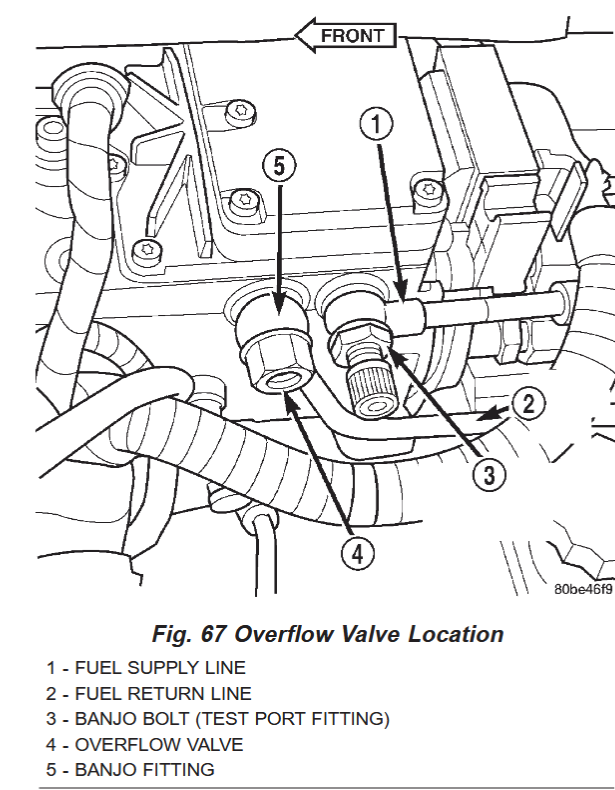
The tech is probably referring to the 14 psi overflow valve in the VP44 injection pump. This pressure control valve is very reliable and I am almost certain it is not your problem. People have replaced this valve because of not understanding how the fuel system works, and then found after replacement, their symptoms didn't change.

Even if the overflow valve failed (as in opening at a lower pressure), it would have little or no effect on lift pump pressure. All fuel that enters the VP44 must pass through in internal fixed displacement vane pump. This pump is regulated at 100 - 300 psi depending on engine rpm and engine load. Because the internal vane pump is fixed displacement, additional fuel cannot be forced through it regardless of lift pump pressure.

Both Airdog and FASS lift pumps use a ball and spring check valve to regulate fuel pressure by recirculating any fuel that is not being used by the injectors and the VP44 cooling system. If the lift pumps are high volume pumps (which yours probably is), then a lot of fuel has to recirculate, in fact more fuel recirculates than gets used. The pressure control valves on these lift pumps are usually not of high quality and the ball and seat can take a beating, which can cause symptoms that you are experiencing. I am surprised that the Tech didn't mention this.

I would be looking at two possibilities for low / erratic lift pump pressure.

  • Check the condition of the ball, spring, and seat in the lift pump.

  • Check for any restriction / leaks in the low pressure fuel supply. Pay special attention to the suction fuel lines from inside the fuel tank to the lift pump.

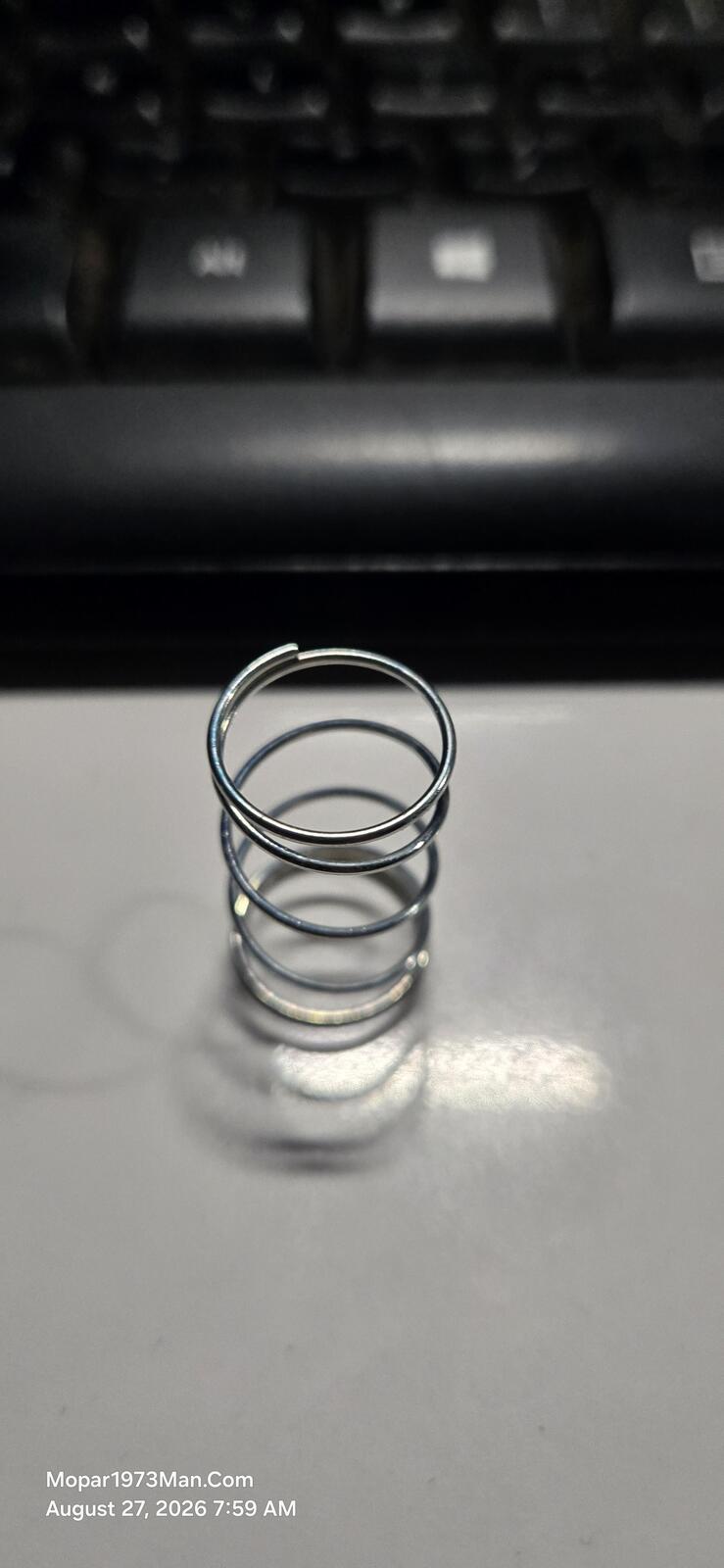
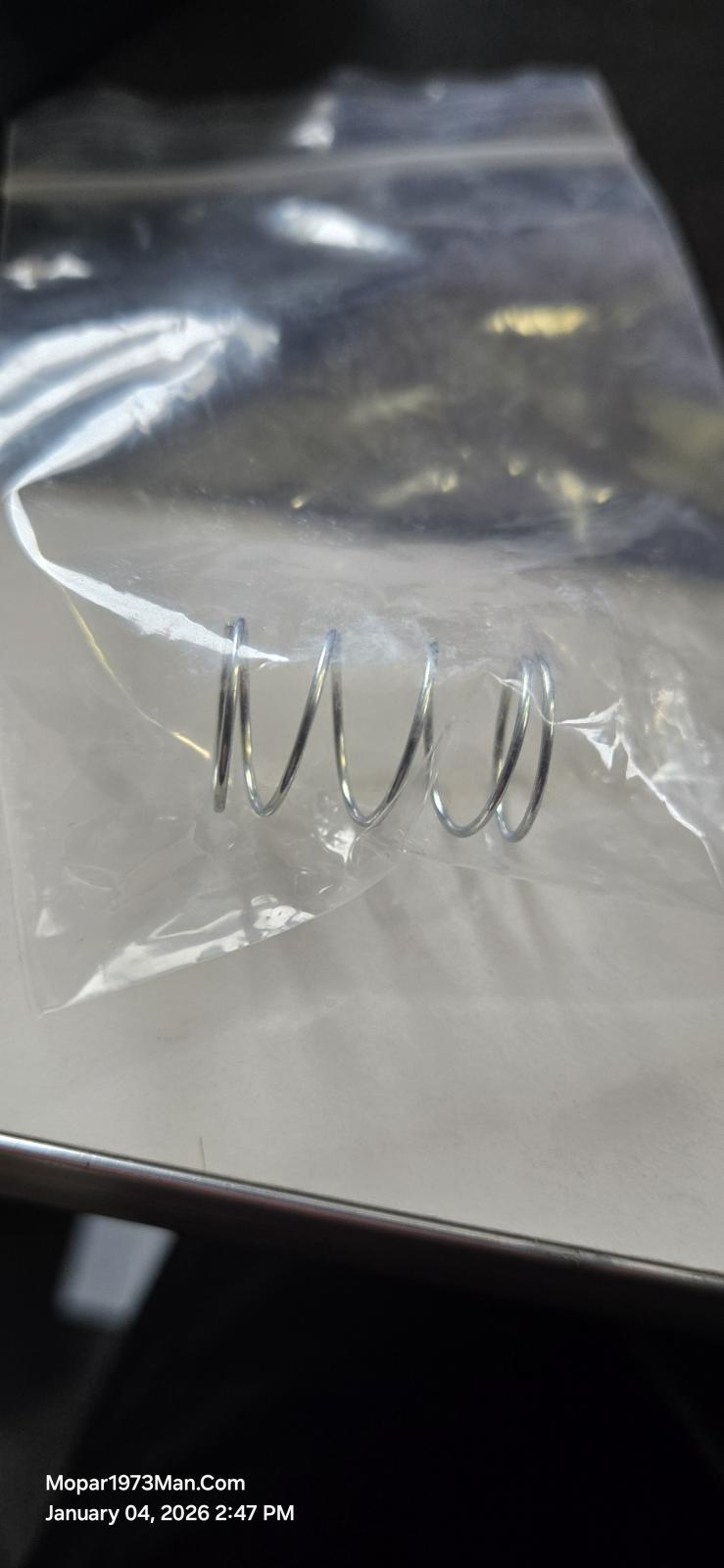
Many people that have observed erratic lift pump pressure have stretched the spring in the lift pump's pressure regulating valve for a bit more tension. For some it gave desired results.

  • John

Edited by Tractorman

  • Author
1 hour ago, Tractorman said:

The tech is probably referring to the 14 psi overflow valve in the VP44 injection pump. This pressure control valve is very reliable and I am almost certain it is not your problem. People have replaced this valve because of not understanding how the fuel system works, and then found after replacement, their symptoms didn't change.

Even if the overflow valve failed (as in opening at a lower pressure), it would have little or no effect on lift pump pressure. All fuel that enters the VP44 must pass through in internal fixed displacement vane pump. This pump is regulated at 100 - 300 psi depending on engine rpm and engine load. Because the internal vane pump is fixed displacement, additional fuel cannot be forced through it regardless of lift pump pressure.

Both Airdog and FASS lift pumps use a ball and spring check valve to regulate fuel pressure by recirculating any fuel that is not being used by the injectors and the VP44 cooling system. If the lift pumps are high volume pumps (which yours probably is), then a lot of fuel has to recirculate, in fact more fuel recirculates than gets used. The pressure control valves on these lift pumps are usually not of high quality and the ball and seat can take a beating, which can cause symptoms that you are experiencing. I am surprised that the Tech didn't mention this.

I would be looking at two possibilities for low / erratic lift pump pressure.

  • Check the condition of the ball, spring, and seat in the lift pump.

  • Check for any restriction / leaks in the low pressure fuel supply. Pay special attention to the suction fuel lines from inside the fuel tank to the lift pump.

Many people that have observed erratic lift pump pressure have stretched the spring in the lift pump's pressure regulating valve for a bit more tension. For some it gave desired results.

  • John

Lift pump has a lifetime warranty. Hopefully I get it narrowed down tomorrow.

1 hour ago, kbf98520 said:

Make sure to double-check the return tee in the rear of the engine; it might be weeping air into the system while parked.

I have not even looked for the tee in the back of the head yet as I have not seen any evidence of fuel leaking from there. What’s the best way to access that tee?

1 hour ago, kbf98520 said:

I have not even looked for the tee in the back of the head yet as I have not seen any evidence of fuel leaking from there. What’s the best way to access that tee?

On my truck the tee at the back of the head started to leak fuel about 15,000 miles ago (at 390,000 miles). At the time I had the transmission out while doing a clutch job and I noticed the leak. The connections were loose, so I just tightened the them from below. They have never leaked since.

A leaking tee fitting (even if it's only leaking air) can cause long cranking times, but it will not affect fuel pressure after the engine is running - so, not likely to be your problem.

I haven't tried accessing the tee fitting from the top of the engine. I would probably remove the valve cover and use a mirror to inspect the connections and then blindly reach around the back of the head to tighten them.

  • John

  • Author
On 12/30/2025 at 8:07 AM, Mopar1973Man said:

@Tractorman Those o-rings are square cut and you would need to order from Cummins for replacement. Might be a good idea.

These are the o rings for the return on back of head?

Fuel pump is back on line. 20+ psi at idle, no less than 17psi WOT. Turns out the problem was the relay. Junk I suppose. This was the relay that came with pump. Eklund brand, I think. Funny, FASS gave me a Bosch part # to replace it with. No one carries Bosch where I live , and rather than waiting on an internet order I replaced with another brand that cross referenced from AutoZone.

Still have the slow start when warm though

22 minutes ago, kbf98520 said:

Still have the slow start when warm though

Does this mean NO slow start when the engine is cold? If so, your lift pump pressure may be too high. The OEM fuel pump setup uses PWM (pulse width modulation) to reduce supply voltage to the lift pump, thus reducing fuel pressure, while cranking. The reasoning is that high lift pump pressure during cranking can affect the position of the timing piston, thus making the engine hard to start when warm. Not everyone has experienced this, but some have.

Is your relay wired directly from the battery?

You could try reducing lift pump pressure to see if this helps starting a warm engine. Don't get caught up in the, "you gotta have at least 14 psi lift pump pressure", as it is not true. Take it down to 12 psi or so at idle and see if that helps.

Good to hear you found the problem with the lift pump.

  • John

Edited by Tractorman

Configure browser push notifications

Chrome (Android)
  1. Tap the lock icon next to the address bar.
  2. Tap Permissions → Notifications.
  3. Adjust your preference.
Chrome (Desktop)
  1. Click the padlock icon in the address bar.
  2. Select Site settings.
  3. Find Notifications and adjust your preference.