Skip to content
View in the app

A better way to browse. Learn more.

Mopar1973Man.Com

A full-screen app on your home screen with push notifications, badges and more.

To install this app on iOS and iPadOS
  1. Tap the Share icon in Safari
  2. Scroll the menu and tap Add to Home Screen.
  3. Tap Add in the top-right corner.
To install this app on Android
  1. Tap the 3-dot menu (⋮) in the top-right corner of the browser.
  2. Tap Add to Home screen or Install app.
  3. Confirm by tapping Install.

30 MPG Documentary

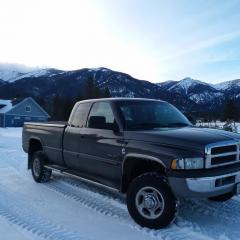
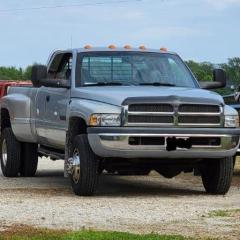
I recently picked up a 98.5 2500 2x4 short bed that had some money thrown at. I decided to take it to the next level and do everything possible to get 30 MPG when empty at 65 mph. I live in a 5th wheel camper and travel for a living, so diesel costs add up!

Please give me your best ideas to improve MPG.

Here is what I've done so far.

  • Front End Aerodynamics on the grill & lower bumper shroud & tonneau cover ( Considering a belly pan underneath )

  • RV 275 Injectors with 7 holes ( Are there better injectors out there for economy ? )

  • 19.5" rims running 245/70 tires that leave me at about 1750 RPM @ 65 mph with 3.55 gears ( Will experiment with smaller stock for less rolling resistance )

  • Quadzilla with an economy tune ( Hoping to get a custom tune when all hardware is done )

  • 205 degree thermostat ( higher temp leads to more complete combustion ) I have an upgraded radiator for pulling

  • Borg Warner K27 turbo 60/70/18 ( The 18 cm^2 exhaust outlet volume is 50% larger than a stock HX35 at 12cm^2 thus reducing back pressure significantly, PDD states that "fat stock like turbos" are known as mileage kings )

  • AFE Bladerunner GT Series intercooler 3" thick ( denser air burns fuel more completely )

  • Full Lock Up Torque Converter

  • 15" Dual Electric Fans ( Stock fan clutch eats 20+ horsepower according to some estimates )

I'm looking for a used gear vendors overdrive as that would get me to 1500 RPM @ 65 Mph ( higher RPMs = Additional fuel burn. Looking to cruise around 1500 RPM's when EMPTY to keep boost near ZERO. )

What ideas do you have ?

Edited by Honestbest333

  • Replies 5
  • Views 123
  • Created
  • Last Reply

Top Posters In This Topic

Most Popular Posts

  • You listed "19.5 tires". Do you mean 19.5 wheels? If so, that could be an issue, wheel/tire combos like that create a lot of rolling resistance. @Mopar1973Man has done a lot of work with his 2001 250

  • That would be a problem that would make your final ratio too tall andf hurt MPG's. Optimally I've found is being between 3.55 to 3.73 for final ratio after tires are figured in. Like myself I dropped

  • Tractor man is right. I'm up here in the frozen north and cold winter days will cause a few things to happen. IAT below 80℉ by design on the ECM will add about 4 degree advancement. This is why my hig

Featured Replies

  • Staff

You listed "19.5 tires". Do you mean 19.5 wheels? If so, that could be an issue, wheel/tire combos like that create a lot of rolling resistance.

@Mopar1973Man has done a lot of work with his 2001 2500 in the way of hyper mileage. Hopefully he will see this and chime in.

@Titanium , oops. Tagged your "old name"

Old habit lol

  • Owner
15 hours ago, Honestbest333 said:
  1. 19.5" tires that leave me at about 1750 RPM @ 65 mph with 3.55 gears

That would be a problem that would make your final ratio too tall andf hurt MPG's. Optimally I've found is being between 3.55 to 3.73 for final ratio after tires are figured in. Like myself I dropped the 265/75R16 and then swapped in the 245/75R16 which changed my final ratio to 3.69:1 at the tires this produces way better torque and pulling power. My out right best was crossing all of Washington state from Seattle WA. to Lewiston ID was 300 miles I barely burned a quarter tank. Optimally the final ratio should be kept bewtween 3.55 to 3.73 for what you are doing with towing. Pay attention rotational mass counts too so heavier tire will hurt your MPG number quick!

15 hours ago, Honestbest333 said:

Borg Warner K27 turbo ( 18 cm^2 exhaust outlet volume is 50% larger than a stock HX35 at 12cm^2 thus reducing back pressure )

Super simple just build a advanced tune on the Quadzilla I can unwind a turbo really easy. Retard adds boost to the power number. It's a balancing act to get the power out of it. The other tidbit I'm running nothing more than a stock HX35W and still getting mid 20's easy. HX35/40 Hybrid turbo (60/60/12) that did really good for MPG being it was just a bit heavier for wheel and boost ran at near zero till 60 MPH. More boost more fuel unlocked and boost needs to be kept LOW!

15 hours ago, Honestbest333 said:

AFE Bladerunner GT Series intercooler 3" thick ( denser air burns fuel more completely )

Actually warmer air is best. IAT of 80 to 140℉ is best! Cooler than 60℉ actually reduces MPG.

15 hours ago, Honestbest333 said:

RV 275 Injectors with 7 holes ( Are there better injectors out there for economy ? )

Trick. I'm running 7 x 0.010 150 HP DAP injectors now and there is a twist in mine I'm running 320 bar not stock 310, 305 or 300 like some injectors. You have to figure that into your tuning. For every 10 bar you change is going to advance 1 degree or retard one degree. So 320 bar made me 1 degree retarded. Quadzilla is set up for fairly retarded tune for towing that way boost builds quick and easy. Advanced timing you can run when your empty.

  • Author

Thank you for all the information above! I'm learning a lot.

Grok AI states:

"Why cooler charge air helps a turbo diesel...

Turbo diesels compress air, which heats it (often to 250–300°F+ under load). An intercooler cools that air before it reaches the engine. Cooler air is denser, so it packs more oxygen molecules into the same volume.

That denser charge improves combustion efficiency: the engine can produce the needed power with less fuel (or more power from the same fuel). Sources commonly cite roughly a 1% density/power gain per ~10°F drop in charge-air temperature, along with corresponding drops in exhaust gas temperature (EGT). A 20°F cooler charge is a meaningful difference (roughly 2–3% denser under typical conditions via the ideal-gas relationship).

Practical results align with the physics. Upgraded intercoolers on diesel trucks (Cummins, Duramax, Power Stroke, etc.) are frequently reported to improve fuel economy in the 2–5% range (sometimes more with supporting tuning), while also cutting EGTs and improving sustained power under load or towing. Banks and others explicitly list better fuel economy as a benefit of larger, well-designed charge-air coolers."

@Honestbest333, everything you posted about charge air is true, but not necessarily relevant for what you are trying to accomplish.

You stated, "I decided to take it to the next level and do everything possible to get 30 MPG when empty at 65 mph." Three key phrases here - "30 mpg", "when empty", and "at 65 mph". Under these conditions, your engine is going to be producing very little boost, thus very little charge air heating. Consequently, light engine load, along with lower engine rpm and a stock intercooler, will easily bring the charge air temperature back to ambient air temperature efficiently - even on a 85°F day. At this point the engine is virtually performing as a naturally aspirated engine and there are more than enough oxygen molecules available for the power being produced.

I think what @Mopar1973Man is alluding to is when you are driving your truck on days when the ambient temperature is 50°F, or 30°F, or 5°F. There are many such days during the winter months. Since your diesel engine does not have a throttle plate (like in a gasoline engine), every intake stroke brings in a full charge of very cold air at low ambient air temperatures. There will likely be less efficient combustion under light engine load in this circumstance. This is where your charge air intercooler can be your enemy.

Once you begin working your engine, such as in towing a 15,000 lb gross combined weight, then everything about cooling the charge air before entering the combustion chamber for better fuel efficiency is relevant - even at lower ambient air temperatures. However, this is not where you are going to achieve 30 mpg, as you well know.

  • John

Edited by Tractorman

  • Owner

Tractor man is right. I'm up here in the frozen north and cold winter days will cause a few things to happen. IAT below 80℉ by design on the ECM will add about 4 degree advancement. This is why my high idle kit with the IAT fooler was created so you can hold the timing from shifting sharply with cold air which in turn reduces the MPG's. Too cold will bring down MPG's. I found that hotter coolant say running a 200℉ thermostat 6.7L Cummins will improve MPG performance providing the added warmth to the engine for cold winters. I end up covering my grill over to block air flow to my intercooler to keep IAT temp up in the bottom end at 70 to 80℉ on a -30℉ winter day.

Racing yes you need a intercooler and keep your temps in check, and Cold air and cooler coolant is great for racing power. But...

MPG is completely flipped backwards. Warmer air is best 80 to 140℉ promote good ignition. Coolant temperature increased to 205 to 210℉ will add +10℉ roughly to the IAT temperature and will keep the timing more productive. I typically run a fairly advanced tune for empty running. Then towing I retard the timing and it build boost quick and hard enough to fry the rear tires on a 7% grade. Optimally you can run about 20° BTDC @ 2000 RPM and its sweet spot for the most part. This will vary depending on pop pressure of the injectors so you may need to adjust timing to fit the set up. Running high pop pressure gives a cleaner bottom end and retards about 1 degree for my 320 bar injectors.

Do not use cetane boosters! Lower the cetane more BTU's per gallon.

There is no benefit to using a higher cetane number fuel than is specified by the engine's manufacturer. The ASTM Standard Specification for Diesel Fuel Oils (D-975) states, "The cetane number requirements depend on engine design, size, nature of speed and load variations, and on starting and atmospheric conditions. Increase in cetane number over values actually required does not materially improve engine performance. Accordingly, the cetane number specified should be as low as possible to insure maximum fuel availability." This quote underscores the importance of matching engine cetane requirements with fuel cetane number!!!

Example on the grid is my locally Cennex Diesel fuel when I looked up their specs.

cetane-btu3.jpg

2 cycle oil is one of the few additives that does not have cetane booster and then if your using snowmobile 2 cycle oil the reduced pour point of the 2 cycle oil (-50°F pour point) that pour point depressant will help with gelling issues of the diesel fuel. 506k miles on Beast and still going!

Then final Ratio another MPG killer. versized tires typically kill the MPG in a few ways. (Optimal ratio for MPGs - 3.73)

  • Rotational mass wider and heavier tires require more power.

  • Larger tires will reduce the ratio number of the axle.

My truck came with 265/75 R16 tires. I changed from that to 245/75 R16 tires like the door panel sticker shows. This shifted my final ratio from 3.55:1 to 3.69:1 and now increased torque output and reduced engine load by a bunch. Cruising at even 80 MPH @ 2450 RPMs no sweat! I've done well over 24 to 26 MPG on the interstate.

Edited by Titanium

Account

Navigation

Search

Search

Configure browser push notifications

Chrome (Android)
  1. Tap the lock icon next to the address bar.
  2. Tap Permissions → Notifications.
  3. Adjust your preference.
Chrome (Desktop)
  1. Click the padlock icon in the address bar.
  2. Select Site settings.
  3. Find Notifications and adjust your preference.