Tractorman
Yearly Subscription
-
Joined
-
Last visited
Everything posted by Tractorman
-
Since only the ECM controls idle rpm, I think that you are going to have to provide some information regarding what your truck is and what repairs and symptoms that triggered high idle rpm. Details matter. John
-
This is just my opinion here, so do not take this as fact. I have never been real concerned about maintaining a maximum specific AC voltage from the alternator. Nobody ever talks about this when diagnosing problems with vehicles that are not 2nd generation Dodge Cummins trucks. Why would they be an different? I am still running my original Bosch alternator (changed brushes twice, bearings once), but still have original diodes. I have checked for AC voltage at least three times in the last ten years. The readings have never be below .05 volts AC. However, I still am running with my original ECM, PCM, and a second APPS. The original APPS lasted for 289,000 miles until it failed (interestingly, with the same code as yours). The APPS I am now running is a Timbo and it has currently logged about a 113,000 miles. So, I can't say that this is absolutely not your problem, but I don't think that it is. Did you use a mulitmeter to check the idle validation switch activation when you loctited the throttle set screw? John
-
That is a good way to test. Will be waiting to hear back. Also, have you verified that the mechanical set screw for the throttle cable is in good condition and that the throttle cable always returns to the mechanical stop when operating the throttle? John
-
Interesting. I copied mine from my 2002 FSM, however your P0121 description actually seems more related to the symptoms that are occurring. What is the source of your information? John
-
You could do that - it could confirm what your scanner is saying. Also, you mentioned that you are getting the P0121 code. P0121 (M) Accelerator Position Sensor (APPS) Signal Voltage Too Low APPS voltage input below the minimum acceptable voltage. You could check this voltage (5 volts supply) at the same time to see if it is fluctuating while the symptoms occur. The condition of wiring and wiring connections (both positive and negative) are crucial on these trucks - so, yes, it is possible for this to be the problem. John
-
This doesn't mean that the APPS is faulty - it just means that there is an output signal at idle when there shouldn't be. Need to know where it is coming from. More troubleshooting needed. Since I don't know what your level of skill is with electricity, I will just start with the basics. Let's say you wanted to check the condition of the crossover cable by using a voltage drop test. First, you would need to understand what would be normal for the test results. There are two batteries (wired in parallel) and a starter on your truck. The starter will draw at least 400 amps when cranking. This means that 200 amps will be supplied by each battery. Consequently, when the starter is operating, the positive and negative cable of the driver side battery and the positive (crossover cable) and negative cables of the passenger side battery will be handling 200 amps each. By design there will always be a voltage drop during the starter operation - there has to be, otherwise current would not flow. The maximum allowable voltage drop in a complete positive circuit is generally .5 volts and in a complete negative circuit is generally .2 volts. The positive circuit has a higher allowable voltage drop because there are usually more switches and connection points than in a negative circuit. Voltage drop measurements can be taken at different points with a voltmeter while the circuit is under an electrical load. Voltage drop tests taken without the circuit under an electrical load will show results that are meaningless. So, back to performing a voltage drop test on the crossover cable. This usually works best using two people. One person will be in the cab and will crank the engine as instructed for a specified period of time. Be sure to be safe - truck in neutral / park and park brake set. Remove the fuel pump relay (in the PDC) for the VP44. This will allow the engine to crank continuously without starting. Set your voltmeter to a manual DC voltage scale of two decimals - example: battery shows 12.67 volts DC on the meter. Do not use the floating scale. Place and hold the positive lead onto the passenger side positive post of the battery (the actual post, not the clamp). Place and hold the negative lead onto the eyelet at the other end of the crossover cable. Your meter should read 0 volts. Instruct the other person to crank the engine for 10 seconds (no interruption). A reading of .1 volts or less during engine cranking indicates that the crossover cable is in very good condition. A reading of .7 volts (for example) during engine cranking would indicate that the cable needs to be replaced. This voltage drop test allows you to see the true condition of the crossover cable while over 200 amps are passing through - a real life situation. John
-
It sounds like you have confirmed that a false signal is being generated in the APPS output circuit. It would stand to reason that the engine rpm's would increase if a signal is present. Back to a previous statement of mine that was meant as a question - are you using the starter for a heavy electrical load when performing your voltage drop tests? By the way, my throttle APPS output always showed zero at idle on the OBDLink scanner. John
-
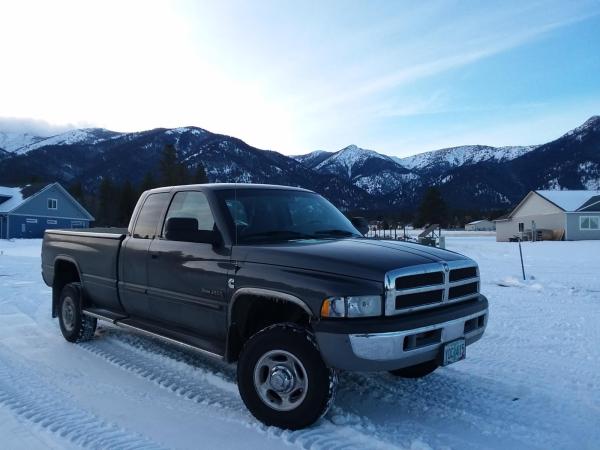 I haven't seen my truck photo anywhere on the site. Where is it supposed to show? Thanks, John
 -
Glad to see you are performing voltage drop tests. Which wire has the .5 voltage drop? I am assuming that you are using the starter for the load while reading these values. I have a Timbo APPS on my truck. I will test it with my OBDlink LX for behavior at idle when I go to town later, and then report back. John
-
Cool! John
-
You should know if you found the problem after letting the truck set for a couple of days. If it fires right up, then I think you have solved the issue. Do you have a fuel pressure in the cab of your truck? John
-
Why do you think your fuel pump is weak? If, in fact, the water separator was the problem, the symptoms that you had - matched the problem. Once enough air was introduced into the suction side of the pump, the pump would struggle to move fuel because the vanes would have been spinning in air - not fuel. This would especially be problematic if the fuel level was low, as the fuel would have to be lifted higher. During your testing, you loosened the downstream filter to help displace the air, but the lift pump still had a source to draw more air (the water separator). Then, when you corrected that issue, the lift pump still did not have any fuel around the vanes, consequently the lift pump still had some difficulty getting primed. Completely normal. Now that fuel is surrounding the vanes in the lift pump and the air leak is fixed, the lift pump will always be primed and ready to start the engine quickly. I think that your lift pump is fine. John
-
Exactly what I would expect. The voltage will bump to above 12 volts with the engine running and voltage at the battery rises to around 14 volts. You could try taking apart the lift pump. I have heard that there can be problems with the relief valve ball and spring - both with Air Dog and FASS. John
-
Set up your inhibiting tool again and cover the end of the tail pipe with your gloved hand (or block of wood) to see if you can feel a cylinder miss. Do the test with the inhibitor on and with it off. Actually, do three tests - inhibitor on, inhibitor off (within the first 10 seconds), and then with the inhibitor off after the noise returns. If there is a miss, you should be able to tell if it is random, multiple cylinders, or just one cylinder. I am just trying to think of ways to get some useful information. I agree that even though it sounds mechanical, why does the sound go away when certain conditions are met? I wouldn't rule out either a timing knock or something mechanical at this point. What about that tone ring? Were you able to perform a complete inspection of the whole tone ring? John
-
But, you can check the voltage at the pump with the pump running. Just probe the wire at the connector and connect the positive lead of you meter. Connect the other lead to the same ground used by the pump. I would expect to see right at 12 volts (maybe slightly less) with the ignition key on, lift pump running, and engine not running. If you see significantly less voltage, then either you have a poor electrical connection, or you have a lift pump that is drawing an abnormal amount of current. I see that there are two fuel filters with your FASS system. Is one a strainer and the other a filter, or are they both downstream filters? Is it possible for one to be plugged? Just covering all bases. John
-
The lift pump should last longer, unless it was starving for fuel. I have a used FASS fuel pump DRP-02 (less than 100 gph) on my truck that has been on the truck for over nine years and over 150,000 miles and it is still working fine. Did you check the voltage of the supply wire with a meter while you were pump from the 5 gallon container? You would want to make sure the power and ground circuit for the pump is functioning properly before you condemn the lift pump. Even if the pump had operational problems, the suction line should have been full of fuel - unless, since there was only about 5 gallons of fuel in the tank, the fuel in the suction line may have just flowed back into the tank as soon as you broke the seal of the fitting. John
-
This is definitely a most unusual problem. I have listened to your video many times. The sound seems mechanical to me, but I can't think of any mechanical issue that would behave the way it does when you inhibit a cylinder and then reactivate the cylinder, or that the sound would go away when the ECM is removed from the loop. Also, the sound is rythmic, like it is only affecting one cylinder. I don't know if any of this is true, but this is what I keep coming back to. Have you partially blocked the exhaust to see if there is a steady miss when the sound is occurring? Have you removed the valve cover to see if anything unusual is happening - with or without the engine running? Can you detect if there is a cylinder miss when the sound is occurring? Gotta figure this one out! John
-
First, I must commend you for a well written description of the symptoms of a problem that you are trying to resolve. People rarely give that attention to detail when describing a symptom or communicating the order of what they have done to resolve the issue. Well done! So, it is interesting that the noise goes away completely with the VP44 running on its own (no ECM communication) and then when the ECM is back in operation, the delayed return of the sound after you inhibit any single cylinder. I don't have the answer, but the fellow you referred to in the above quote may be on to something here. The VP44 has an internal encoder that replicates and compares the crank / cam sensor signal, which could explain why the noise is gone when the ECM is out of the loop (the VP44 no longer needs the crank / cam sensor). And, maybe, when you inhibit a cylinder there is a delay in the knock returning possibly because the timing shifted from the internal encoder to the crank / cam sensor? Just speculating here. Another very good possibility is that if your truck uses a crank sensor, the ring on the flywheel that triggers the sensor may be loose, cracked, or partly missing. JohnI have not experienced your situation, but from what I have read from related past postings on this site, you are in need of a rebuilt ECM. The ECM basically will not boot up, or won't finish booting up, so no engine start. JohnDon't have any answers, just waiting to see what the APPS reset offers. It will be interesting to see if the Quadzilla is the culprit. JohnIf you don't mind a few questions after you have had some time in the seat, I would like to know a few things regarding transmission converter lockup / exhaust brake operation under certain driving conditions. Enjoy the truck - I'm sure it is going tow effortlessly. JohnJust read this. I would imagine that Mark thought that the end of his world had arrived when that event happened. I'm glad to hear that he didn't suffer any major injuries, or worse. I cannot offer any immediate help for the next two weeks, but after that, let me know if there is something that I can do. I do have a small excavator (about 3500 lbs and it has a thumb) and a dump trailer that I could use to work through the debris, but the excavator would not be able to handle large rocks - say, over 500 lbs. I could scoot some bigger rocks around, just won't be able to lift them. Is your house in any danger of a similar slide? JohnGood to hear you are back up and running. Good timing to reseal the vacuum pump and the side cover. I would be very interested in hearing your thoughts regarding the 2025 Ram 8 spd transmission after you drive it for awhile. Are using the new Ram for your upcoming trip? JohnAn air intake leak on a diesel powered engine of this era will not affect engine idle or cause the engine to die. This is because fuel is directly injected into the engine cylinder - the engine won't care where the air came from. An intake leak could cause poor performance under load because of loss of boost and it will allow unfiltered air to enter the engine which can cause engine damage over time. An air intake leak on a gasoline powered engine will affect engine idle or cause the engine to die because the leak would alter the air to fuel ratio in the intake manifold. John