
Jump to content
View in the app

A better way to browse. Learn more.

Mopar1973Man.Com LLC

A full-screen app on your home screen with push notifications, badges and more.

To install this app on iOS and iPadOS
  1. Tap the Share icon in Safari
  2. Scroll the menu and tap Add to Home Screen.
  3. Tap Add in the top-right corner.
To install this app on Android
  1. Tap the 3-dot menu (⋮) in the top-right corner of the browser.
  2. Tap Add to Home screen or Install app.
  3. Confirm by tapping Install.

Mopar1973Man

Owner
  • Joined

  • Last visited

Everything posted by Mopar1973Man

  1. Correct. You need to calibrate you ScanGauge II to get it display real numbers. Typical 18 MPG @ 65 MPH will be 3.61 GPH. So like another would 22 MPG @ 55 MPH will be 2.5 GPH. Fuel Type: Diesela
  2. FRONT AXLE DISCONNECT SYSTEM TECHNICAL SERVICE BULLETIN Reference Number(s): 03-001-02, Date of Issue: February 11, 2002 DODGE: 2002 (BE/BR) Ram Truck GROUP: Front Axle DESCRIPTION Front Axle Disconnect System This bulletin involves a mid-2002 model year deletion of the front axle disconnect system on 2002 (BE/BR) 2500 and 3500 Ram Trucks. This change effects the front axle, transfer case and engine/headlamp and dash wiring harnesses. BULLETIN CONTENT This bulletin involves a mid-2002 model year deletion of the front axle disconnect system on the 2002 (BE/BR) 2500 and 3500 Ram Trucks. This change effects the front axle, transfer case, and engine, headlamp and dash wiring harnesses. MODELS 2002 (BE/BR) Ram truck NOTE: THIS BULLETIN APPLIES TO 2500 AND 3500 (BE/BR) RAM TRUCKSBUILT AFTER JANURARY 4, 2002 AND EQUIPPED WITH FRONT AXLES WITH THE FOLLOWING PART NUMBERS: 52070136AO, 52070137AO, 52070138AP, AND 52070139A0. DISCUSSION: The vehicles involved will retain Shift On the Fly (SFO) capability, however with this change, the front driveshaft will now turn continously when the vehicle is being driven. When the vehicles is stopped in 2WD the front driveshaft will no longer spin freely. The 4WD indicator light on the instrument panel is now controlled by a switch on the transfer case. If there is a mechanical problem causing loss of 4WD the indicator light will be "ON" if the shifter is in the "4WD HI" or "4WD LO" position. If the indicator light is not function properly when the transfer case shifter is in the 4WD position, the transfer case switch, dashboard indicator light or circuit should be diagnosed first. Parts required for service on vehicles with this change are readily available already identified in the Mopar Part Catalog. NOTE: DUE TO THE TIMING OF THIS INFORMATION IS NOT REFLECTED IN THE SERVICE MANUAL (PUBLICATION #81-370-02057). NOTE: DIAGNOSTIC AND SERVICE PROCEDURES FOR THE FRONT AXLE DISCONNECT SYSTEM, RELATED VACUUM LINES, THE TRANSFER CASE SYNCHRONIZER ASSEMBLY, MAIN SHAFT ASSEMBLY, HUB, STRUTS, RETAINING RING, SLIDING CLUTCH AND SPRING SHOULD BE DISREGARDED. SERVICE INFORMATION TO THE SUPPORT THIS CHANGE IS CURRENTLY BEING DEVELOPED AND WILL BE ON A FUTURE MDS2 CD RELEASE WHEN DEVELOPMENT IS COMPLETE. POLICY Information Only.
  3. TOE IN SPECIFICATION CHANGE TECHNICAL SERVICE BULLETIN Reference Number(s): 02-003-02, Date of Issue: June 17, 2002 DODGE: BR/BE Ram Truck GROUP: Front Suspension OVERVIEW This bulletin involves an update to the toe in specification for front end alignments. DISCUSSION The specification for toe in has been revised to 0.2° +/- 0.1° total toe in. This change has been shown to improve straight ahead performance and should be used whenever a front end alignment is performed. POLICY Information Only
  4. Mine shows... LOD = 0 GPH = 0 MPG = 9999 As soon as any load is placed on the engine the numbers all pop up. I've got Version 1.00 software on my ScanGauge II. I really do need to update the software bad.
  5. Here you go... Double check the PDC plug that has the bolt in it. Make sure to be very gentle about tightening the bolt it strips out extremely easy.
  6. Might ask Dripley... I remember him talking about have a paper weight ECM.
  7. There is a great company right here in Idaho... Worth tlaking to them... http://modulemaster.com/rebuilds/
  8. Raptors are known for this problem. I've got a dead Raptor on my bench that the seal ate the shaft of the pump. Rubber seal capable of eating a steel shaft... What's wrong with that picture?
  9. LOL... It'll take a few days of work. I don't have instant resources here where I'm at. Then playing tag with the owner by email or phone delays things too. I'm sure I've got 3 more trucks to play with as well. One of them is a CR with a bad cylinder no compression in one hole. I've also got a fork lift to fix yet but got to wait till spring for it. Then the bonus project is making a custom truck for him as well. That is way down the road.
  10. I've been given the green light by the owner to work on the next truck. I've got to share this with you all very nice looking 2nd Gen... I had to dig it out of New Meadows, ID. It was buried rather nicely with quite a bit of snow on it. I know I got to do front end work. Sloppy steering. 4WD doesn't work (vacuum issues). Shocks are worn out and got some bounce and sway. Got it home for the time being that is the first step.
  11. I rather deal directly with the company not a Ebay page. I've seen too many times where deals too good to be true and then BAM! Gone... No one to warranty the product.
  12. http://pubfilm.com/the-big-short-2015-full-hd-pubfilm-free.html http://moviepilot.com/posts/3752873
  13. Things will improve quickly. Right now there is only one way to find it being through the site. When the search engine start to pick up and change over it will improve more giving more options of access. Strange though just in the last 2 days the site traffic is up 500 people more. Hanging out at 1,500 or so a day come to the site. It was floating at about 900 to 1000 or so in the old lay out.
  14. Wait to start light coming on instantly with the key? If its delayed at all the engine will not start or do much of anything till the WTS light comes on.
  15. This is about on the mark. Like myself I've escaped this for the most part by using smaller tires. Oversized tires will impact this more so and require more beefing up of the transmission to hold up. As for the 5th gear nut I'm still going strong no issues.
  16. Don't feel bad guys neither my PC's or my tablet worked with the look up. Linux by default will not work with online PDF files. I did manage to add a plugin to work with PC's. Now my Android tablet its still not working either. Thing is the information is here you might have to use a PC to use it for the time being but at least its here, We'll continue to improve the site and the code as time goes on!
  17. This is why the ECM controls the lift pump so when tach signal drops to zero the lift pump is shut down. This will prevent a lift pump feeding a fire that might of occurred from a vehicle accident.
  18. The instrument cluster actuator test will put the instrument cluster into its self-diagnostic mode. In this mode the instrument cluster can perform a self diagnostic test that will confirm that the instrument cluster circuitry, the gauges, and the CCD data bus message-controlled indicators are capable of operating as designed. During the actuator test the instrument cluster circuitry position each of the gauge needles at various calibration points, illuminate each of the segments in the Vacuum-Fluorescent Display (VFD), and turn all of the CCD data bus message controlled indicators on and off. Successful completion of the actuator test will confirm that the instrument cluster is operational. However, there may still be a problem with the CCD data bus, the Powertrain Control Module (PCM), the Engine Control Module (ECM), the Airbag Control Module (ACM), the Controller Anti-lock Brake (CAB), or the inputs to one of these electronic control modules.Use a DRBIII scan tool to diagnose these components. Refer to the appropriate diagnostic information. 1. Begin the test with the ignition switch in the Off position. 2. Depress the odometer/trip odometer switch button. 3. While still holding the odometer/trip odometer switch button depressed, turn the ignition switch to the On position, but do not start the engine. 4. Keep the odometer/trip odometer switch button depressed for about ten seconds, until CHEC appears in the odometer display, then release the odometer/trip odometer switch button. 5. A series of three-digit numeric failure messages may appear in the odometer display, depending upon the failure mode. If a failure message appears, refer to the Instrument Cluster Failure Message chart for the description and proper correction. If no failure message appears, the actuator test will proceed as described in Step 6. 6. The instrument cluster will begin the Vacuum Fluorescent Display (VFD) walking segment test. This test will require the operator to visually inspect each VFD segment as it is displayed to determine a pass or fail condition. First, all of the segments will be illuminated at once; then, each individual segment of the VFD will be illuminated in sequence. If any segment in the display fails to illuminate, repeat the test to confirm the failure. If the failure is confirmed, replace the faulty instrument cluster. Following completion of the VFD walking segment test, the actuator test will proceed as described in Step 7. 7. The instrument cluster will perform a bulb check of each indicator that the instrument cluster circuitry controls. If the wait-to-start indicator does not illuminate during this test, the instrument cluster should be removed. However, check that the incandescent bulb is not faulty and that the bulb holder is properly installed on the instrument cluster electronic circuit board before considering instrument cluster replacement. If the bulb and bulb holder check OK, replace the faulty instrument cluster. Each of the remaining instrument cluster circuitry controlled indicators except the cruise indicator are illuminated by a Light Emitting Diode (LED). If an LED or the cruise indicator in the VFD, fails to illuminate during this test, the instrument cluster must be replaced. Following the bulb check test, the actuator test will proceed as described in Step 8. 8. The instrument cluster will perform a gauge actuator test. In this test the instrument cluster circuitry positions each of the gauge needles at three different calibration points, then returns the gauge needles to their relaxed positions. If an individual gauge does not respond properly, or does not respond at all during the gauge actuator test, the instrument cluster should be removed. However, check that the gauge terminal pins are properly inserted through the spring-clip terminal pin receptacles on the instrument cluster electronic circuit board before considering instrument cluster replacement. If the gauge terminal connections are OK, replace the faulty instrument cluster. 9. The actuator test is now completed. The instrument cluster will automatically exit the self-diagnostic mode and return to normal operation at the completion of the test, if the ignition switch is turned to the Off position during the test, or if a vehicle speed message indicating that the vehicle is moving is received from the PCM on the CCD data bus during the test. 10. Go back to Step 1 to repeat the test, if required.
  19. SEATBELT CONTROL TIMER MODULE DESCRIPTION The Seatbelt Control Timer Module (SCTM) is secured to a bracket underneath the front edge of the front seat center cushion. The SCTM mounting bracket also serves as the support for the slide-out rear seat cup holder unit. The SCTM contains an electromechanical Gravity (G)-sensor and an electronic timer circuit. The SCTM receives hard wired external inputs from the ignition switch and both door jamb switches. The SCTM monitors the external inputs, as well as the inputs from its internal timer and G-sensor. In response to those inputs, the SCTM controls hard wired battery voltage outputs to both electric front seat belt retractor latch solenoids. The SCTM also sends diagnostic outputs to the Airbag Control Module (ACM) over a hard wired fault circuit. For diagnosis of the CCD data bus, the ACM or the fault circuit input to the ACM from the SCTM, the use of a DRB scan tool and the proper Diagnostic Procedures manual are recommended. The SCTM cannot be adjusted or repaired and, if faulty or damaged, must be replaced. OPERATION The SCTM provides battery current to energize the electric seat belt retractor latch solenoids whenever the ignition switch is in the On or Accessory positions, unless the G-sensor input indicates a vehicle condition that requires the seat belt retractor to be latched. When the seat belt retractor latch solenoids are energized the retractor spools are unlatched, and the seat belt webbing can be extracted from the retractor. When the solenoids are de-energized the retractor spools latch, preventing the seat belt webbing from being extracted further from the retractor. This logic ensures that the seat belts will be latched and remain latched if battery power is lost during a vehicle collision. The electromechanical G-sensor within the SCTM monitors the rate of vehicle acceleration and deceleration in any horizontal direction. The G-sensor also responds to the horizontal attitude of the vehicle. If the G-sensor monitors a gravity force of greater than about 0.7G in any horizontal direction, or that the vehicle is tilted in any direction at an angle of greater than about 45 degrees, the SCTM will sense the input from the G-sensor and de-energize the seat belt retractor latch solenoids. The SCTM electronic timer circuit provides the vehicle occupants with the ability to extract the seat belt webbing from the retractor spool for a time period of about 30 minutes after the ignition switch is turned to the Off position, unless the G-sensor input indicates a vehicle condition that requires the seat belt retractor to be latched. The electronic timer circuit also monitors the state of the door jamb switches, and unlatches the seat belt retractors after either door jamb switch cycles from open to closed or from closed to open. Each time the SCTM receives an input indicating a change in the state of a monitored switch has occurred, the 30 minute timer starts again. The timer de-energizes the retractor latch solenoids after about 30 minutes to prevent the battery from being drained while the vehicle is not being driven. The hard wired SCTM fault circuit output to the ACM is used to indicate whether a fault condition is present in the electronic seat belt control system. The ACM continuously monitors the SCTM fault circuit and sends the proper messages to the instrument cluster over the Chrysler Collision Detection (CCD) data bus to turn the seat belt reminder lamp on or off. When no faults are present or monitored by the SCTM, the normal voltage range on the SCTM fault circuit is between one and three volts. If the ACM detects voltages outside the normal range on this circuit, or does not detect any input from the SCTM, it sets a fault code and sends messages to the instrument cluster to turn the seat belt reminder lamp on. SEATBELT CONTROL TIMER MODULE For complete circuit diagrams, refer to Restraint System in the Contents of Wiring Diagrams. Check the fused B(+) fuse in the junction block. If OK, go to Step 2. If not OK, repair the shorted circuit or component as required and replace the faulty fuse. Check for battery voltage at the fused B(+) fuse in the junction block. If OK, go to Step 3. If not OK, repair the open fused B(+) circuit to the battery as required Check the fused ignition switch output (run-acc) fuse in the junction block. If OK, go to Step 4. If not OK, repair the shorted circuit or component as required and replace the faulty fuse Turn the ignition switch to the On position. Check for battery voltage at the fused ignition switch output (run-acc) fuse in the junction block. If OK, go to Step 5. If not OK, repair the open fused ignition switch output (run-acc) circuit to the ignition switch as required. Turn the ignition switch to the Off position. Disconnect and isolate the battery negative cable. Disconnect the wire harness connector from the connector receptacle of the Seatbelt Control Timer Module (SCTM) Reconnect the battery negative cable. Check for battery voltage at the fused B(+) circuit cavity of the wire harness connector for the SCTM. If OK, go to Step 6. If not OK, repair the open fused B(+) circuit to the junction block fuse as required. Turn the ignition switch to the On position. Check for battery voltage at the fused ignition switch output (run-acc) circuit cavity of the wire harness connector for the SCTM. If OK, go to Step 7. If not OK, repair the open fused ignition switch output (run-acc) circuit to the junction block fuse as required. Turn the ignition switch to the Off position. Disconnect and isolate the battery negative cable. Check for continuity between the ground circuit cavity of the wire harness connector for the SCTM and a good ground. There should be continuity. If OK, go to Step 8. If not OK, repair the open ground circuit to ground as required. Check for continuity between the right door ajar switch sense circuit cavity of the wire harness connector for the SCTM and a good ground. There should be no continuity with the right front door closed, and continuity with the right front door open. Repeat this test for the left door ajar switch sense circuit. If both circuits check OK, and the problem is with only one inoperative electric seat belt retractor latch solenoid, refer to Electric Seat Belt Retractor Latch Solenoid in the Diagnosis and Testing section of this group. If both circuits check OK, and the problem is with both electric seat belt retractor latch solenoids being inoperative, replace the faulty SCTM. If either or both door ajar switch sense circuits is not OK, refer to Door Jamb Switch in the Diagnosis and Testing section of Vehicle Theft/Security Systems. ELECTRIC SEAT BELT RETRACTOR LATCH SOLENOID For complete circuit diagrams, refer to Restraint System in the Contents of Wiring Diagrams. Disconnect and isolate the battery negative cable. Disconnect the seat wire harness connector from the connector receptacle of the Seatbelt Control Timer Module (SCTM) Check the resistance between the inoperative (driver side or passenger side) seat belt solenoid control circuit cavity of the seat wire harness connector for the SCTM and a good ground. The correct resistance should be from 50 to 60 ohms. If OK, refer to Seatbelt Control Timer Module in the Diagnosis and Testing section of this group. If not OK, go to Step 3. Disconnect the seat wire harness connector from the connector receptacle of the inoperative (driver or passenger) electric seat belt retractor latch solenoid. Check the resistance between the two terminals in the connector receptacle of the electric seat belt retractor latch solenoid. The correct resistance should be from 50 to 60 ohms. If OK, go to Step 4. If not OK, replace the faulty seat belt retractor unit. Check the resistance between the ground circuit cavity of the seat wire harness connector for the electric seat belt retractor latch solenoid and a good ground. There should be no measurable resistance. If OK, repair the open (driver side or passenger side) seat belt solenoid control circuit between the seat wire harness connectors for the electric seat belt retractor latch solenoid and the SCTM as required. If not OK, repair the ground circuit to ground as required.
  20. The coolant temperature gauge for normal span is roughly 165*F to 225*F from left tick mark to right tick mark. Here the coolant sensor is operating and at 164*F the needle is barely off the mark on the cold side. Here the temperature is fooled to 216*F but not quite there to the tick mark figuring its going to be about 225*F at the mark.
  21. Mopar1973Man posted an Cummins article in Fuel
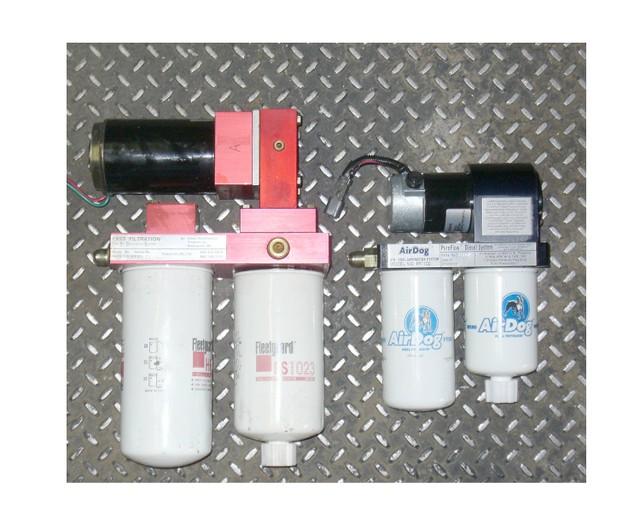
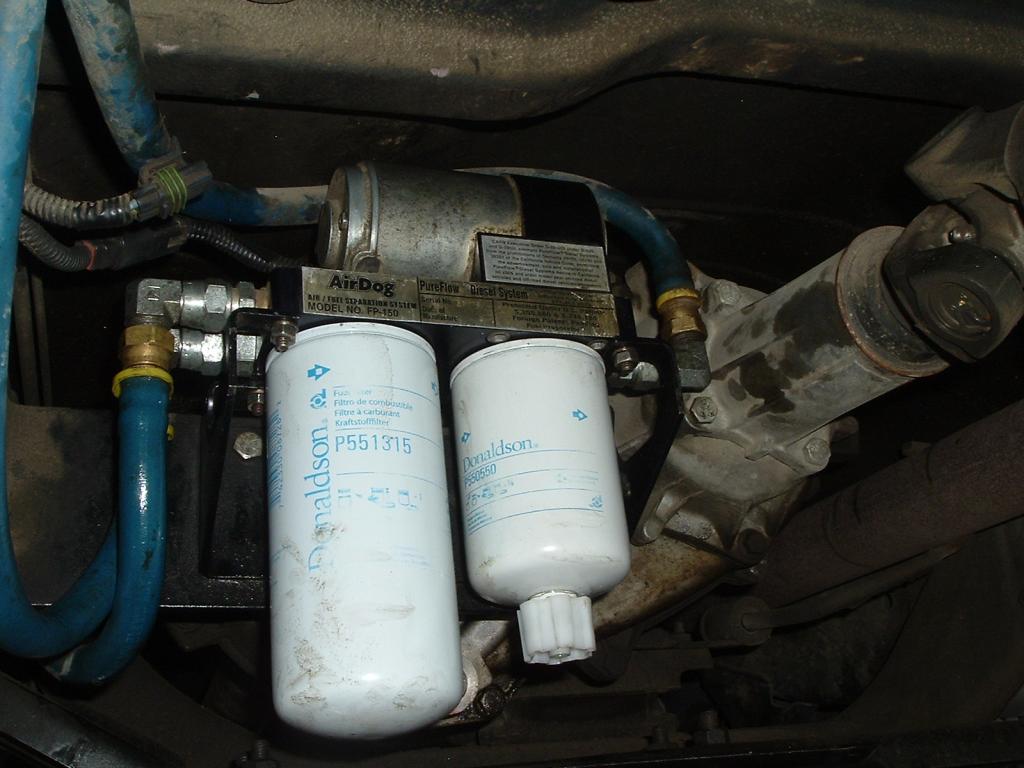
    AirDog 100/150 Filters NumbersAirDog 100 & AirDog 150 Part Number FF100-10 (10 Micron) Fleetguard FF5617 FF100-5 (5 Micron) Fleetguard FF5587 FF100-3 (3 Micron) Fleetguard FF5613 2 micron fuel filter NAPA 3626 WS80 (Water Separator) Fleetguard FS19768 WS100 (Water Separator) Luber-Finer LFF9594 SuperDog Filter NumbersSuperDog 200 Part Number FF200-10 (10 Micron) Fleetguard FS1054 WS200 (Water Separator) Fleetguard FS1023 PureFlow P/N Cross Reference P/N Manufacturer AirDog FF100-10 FF5617 - Fleetguard 10um absolute, 60GPH AirDog FF100-5 FF5587 - Fleetguard discontinued AirDog FF100-3 FF5613 - Fleetguard 5um absolute 60GPH AirDog WS80 FS19768 - Fleetguard 0% emulsified water/50% free water sep 20 GPH AirDog WS100 LFF9594 - Luber-Finer 95% free water/75% emulsified water sep 90 GPH NAPA Part # 3626 2 micron fuel filter works on the airdog!!! 6um nominal! More numbers supplied by 1lowdiesel @ CumminsForum (AirDog Tech) Napa / Wix 3527 & 33527 Napa / Wix 3697 & 33697 Napa / Wix 3420 & 33420 Napa / Wix 3616 & 33616 CAT 1R-0751 CAT 1R-0750 Donaldson P551315 Baldwin BF1275 Fleetguard FS19768 Baldwin BF7634 FleetGuard FF5324
  22. AirDog 100/150 Filters NumbersAirDog 100 & AirDog 150 Part Number FF100-10 (10 Micron) Fleetguard FF5617 FF100-5 (5 Micron) Fleetguard FF5587 FF100-3 (3 Micron) Fleetguard FF5613 2 micron fuel filter NAPA 3626 WS80 (Water Separator) Fleetguard FS19768 WS100 (Water Separator) Luber-Finer LFF9594 SuperDog Filter NumbersSuperDog 200 Part Number FF200-10 (10 Micron) Fleetguard FS1054 WS200 (Water Separator) Fleetguard FS1023 PureFlow P/N Cross Reference P/N Manufacturer AirDog FF100-10 FF5617 - Fleetguard 10um absolute, 60GPH AirDog FF100-5 FF5587 - Fleetguard discontinued AirDog FF100-3 FF5613 - Fleetguard 5um absolute 60GPH AirDog WS80 FS19768 - Fleetguard 0% emulsified water/50% free water sep 20 GPH AirDog WS100 LFF9594 - Luber-Finer 95% free water/75% emulsified water sep 90 GPH NAPA Part # 3626 2 micron fuel filter works on the airdog!!! 6um nominal! More numbers supplied by 1lowdiesel @ CumminsForum (AirDog Tech) Napa / Wix 3527 & 33527 Napa / Wix 3697 & 33697 Napa / Wix 3420 & 33420 Napa / Wix 3616 & 33616 CAT 1R-0751 CAT 1R-0750 Donaldson P551315 Baldwin BF1275 Fleetguard FS19768 Baldwin BF7634 FleetGuard FF5324 View full Cummins article
  23. Mopar's Notes: Here is the result of leaving the stock crankcase vent in place and the problems it causes like overheating... Here is the story from Edcasey from Cummins forum at Should of lost my puke bottle a long ago I finally got around to doing Mopar1973Man's mod for the puke bottle. I knew I needed to clean my radiator even before this happened. My truck ran hot (215 - 220 degrees) in stop and go traffic or when towing my 3000 pound trailer. Also, at idle, my air conditioner barely worked. It all pointed to an air flow problem. So I pulled the radiator and I would say this is an air flow problem: So I used some degreaser and my power washer to clean everything. So once that was done I went to work on the new vent setup. It's Mike's design just plumbed slightly different (probably still a patent infringement). While I had it all apart, I flushed the cooling system and changed the thermostat. When it was back together I took it for a test drive. It heated up to 190 degrees much faster than before thanks to the new thermostat. When the thermostat opened it actually dropped down to about 185 degrees. I've driven this truck daily for about 4 years and it has never done that. I decided to take it for a ride through the city. I spent 45 minutes in stop and go traffic with the air conditioner on and it never went above 190 degrees. Before it would have gone to about 215. It was definitely worth the time it took and I should have done it a long time ago. The down pipe I kept short enough that road debris will not strike the downpipe as well as keeping up near the engine heat in hopes to keep it from freezing shut. Take notice the steep angle cut on the end of the pipe added to keep the tip from possibly freezing shut as well.
  24. Mopar1973Man posted an Cummins article in Electrical
    Starter Description The starter motors used for the 5.9L diesel engine and the 8.0L gasoline engine available in this model are not interchangeable with each other, or with the starter motors used for the other available engines. The starter motor for the 5.9L diesel engine is mounted with three screws to the flywheel housing on the left side of the engine. Each of these starter motors incorporates several of the same features to create a reliable, efficient, compact, lightweight and powerful unit. The electric motors of all of these starters have four brushes contacting the motor commutator, and feature four electromagnetic field coils wound around four pole shoes. The 3.9L, 5.2L, 5.9L and 8.0L gasoline engine starter motors are rated at 1.4 kilowatts (about 1.9 horsepower) output at 12 volts, while the 5.9L diesel engine starter motor is rated at 2.7 kilowatts (about 3.6 horsepower) output at 12 volts. All of these starter motors are serviced only as a unit with their starter solenoids, and cannot be repaired. If either component is faulty or damaged, the entire starter motor and starter solenoid unit must be replaced. Operation These starter motors are equipped with a gear reduction (intermediate transmission) system. The gear reduction system consists of a gear that is integral to the output end of the electric motor armature shaft that is in continual engagement with a larger gear that is splined to the input end of the starter pinion gear shaft. This feature makes it possible to reduce the dimensions of the starter. At the same time, it allows higher armature rotational speed and delivers increased torque through the starter pinion gear to the starter ring gear. The starter motors for all engines are activated by an integral heavy duty starter solenoid switch mounted to the overrunning clutch housing. This electromechanical switch connects and disconnects the feed of battery voltage to the starter motor, also engaging and disengaging the starter pinion gear with the starter ring gear. All starter motors use an overrunning clutch and starter pinion gear unit to engage and drive a starter ring gear that is integral to the flywheel (manual transmission), torque converter or torque converter drive plate (automatic transmission) mounted on the rear crankshaft flange. Diagnosis & Testing - Starter Motor Correct starter motor operation can be confirmed by performing the following free running bench test. This test can only be performed with starter motor removed from vehicle. Refer to Starter Specifications for starter motor specifications. (1) Remove starter motor from vehicle. Refer to Starter Motor Removal and Installation. (2) Mount starter motor securely in a soft-jawed bench vise. The vise jaws should be clamped on mounting flange of starter motor. Never clamp on starter motor by field frame. (3) Connect suitable volt-ampere tester and 12-volt battery to starter motor in series, and set ammeter to 100 ampere scale (250 ampere scale for diesel engine starters). See instructions provided by manufacturer of volt-ampere tester being used. (4) Install jumper wire from solenoid terminal to solenoid battery terminal. The starter motor should operate. If starter motor fails to operate, replace faulty starter motor assembly. (5) Adjust carbon pile load of tester to obtain free running test voltage. Refer to Specifications for the starter motor free running test voltage specifications. (6) Note reading on ammeter and compare this reading to free running test maximum amperage draw. Refer to Specifications for starter motor free running test maximum amperage draw specifications. (7) If ammeter reading exceeds maximum amperage draw specification, replace faulty starter motor assembly. Diagnosis & Testing - Starter Motor Solenoid This test can only be performed with starter motor removed from vehicle. (1) Remove starter motor. Refer to Starter Motor Removal and Installation. (2) Disconnect wire from solenoid field coil terminal. (3) Check for continuity between solenoid terminal and solenoid field coil terminal with continuity tester (Fig. 7). There should be continuity. If OK, go to Step 4. If not OK, replace faulty starter motor assembly. (4) Check for continuity between solenoid terminal and solenoid case (Fig. 8). There should be continuity. If not OK, replace faulty starter motor assembly.
  25. Starter Description The starter motors used for the 5.9L diesel engine and the 8.0L gasoline engine available in this model are not interchangeable with each other, or with the starter motors used for the other available engines. The starter motor for the 5.9L diesel engine is mounted with three screws to the flywheel housing on the left side of the engine. Each of these starter motors incorporates several of the same features to create a reliable, efficient, compact, lightweight and powerful unit. The electric motors of all of these starters have four brushes contacting the motor commutator, and feature four electromagnetic field coils wound around four pole shoes. The 3.9L, 5.2L, 5.9L and 8.0L gasoline engine starter motors are rated at 1.4 kilowatts (about 1.9 horsepower) output at 12 volts, while the 5.9L diesel engine starter motor is rated at 2.7 kilowatts (about 3.6 horsepower) output at 12 volts. All of these starter motors are serviced only as a unit with their starter solenoids, and cannot be repaired. If either component is faulty or damaged, the entire starter motor and starter solenoid unit must be replaced. Operation These starter motors are equipped with a gear reduction (intermediate transmission) system. The gear reduction system consists of a gear that is integral to the output end of the electric motor armature shaft that is in continual engagement with a larger gear that is splined to the input end of the starter pinion gear shaft. This feature makes it possible to reduce the dimensions of the starter. At the same time, it allows higher armature rotational speed and delivers increased torque through the starter pinion gear to the starter ring gear. The starter motors for all engines are activated by an integral heavy duty starter solenoid switch mounted to the overrunning clutch housing. This electromechanical switch connects and disconnects the feed of battery voltage to the starter motor, also engaging and disengaging the starter pinion gear with the starter ring gear. All starter motors use an overrunning clutch and starter pinion gear unit to engage and drive a starter ring gear that is integral to the flywheel (manual transmission), torque converter or torque converter drive plate (automatic transmission) mounted on the rear crankshaft flange. Diagnosis & Testing - Starter Motor Correct starter motor operation can be confirmed by performing the following free running bench test. This test can only be performed with starter motor removed from vehicle. Refer to Starter Specifications for starter motor specifications. (1) Remove starter motor from vehicle. Refer to Starter Motor Removal and Installation. (2) Mount starter motor securely in a soft-jawed bench vise. The vise jaws should be clamped on mounting flange of starter motor. Never clamp on starter motor by field frame. (3) Connect suitable volt-ampere tester and 12-volt battery to starter motor in series, and set ammeter to 100 ampere scale (250 ampere scale for diesel engine starters). See instructions provided by manufacturer of volt-ampere tester being used. (4) Install jumper wire from solenoid terminal to solenoid battery terminal. The starter motor should operate. If starter motor fails to operate, replace faulty starter motor assembly. (5) Adjust carbon pile load of tester to obtain free running test voltage. Refer to Specifications for the starter motor free running test voltage specifications. (6) Note reading on ammeter and compare this reading to free running test maximum amperage draw. Refer to Specifications for starter motor free running test maximum amperage draw specifications. (7) If ammeter reading exceeds maximum amperage draw specification, replace faulty starter motor assembly. Diagnosis & Testing - Starter Motor Solenoid This test can only be performed with starter motor removed from vehicle. (1) Remove starter motor. Refer to Starter Motor Removal and Installation. (2) Disconnect wire from solenoid field coil terminal. (3) Check for continuity between solenoid terminal and solenoid field coil terminal with continuity tester (Fig. 7). There should be continuity. If OK, go to Step 4. If not OK, replace faulty starter motor assembly. (4) Check for continuity between solenoid terminal and solenoid case (Fig. 8). There should be continuity. If not OK, replace faulty starter motor assembly. View full Cummins article

Configure browser push notifications

Chrome (Android)
  1. Tap the lock icon next to the address bar.
  2. Tap Permissions → Notifications.
  3. Adjust your preference.
Chrome (Desktop)
  1. Click the padlock icon in the address bar.
  2. Select Site settings.
  3. Find Notifications and adjust your preference.