Tractorman
Yearly Subscription
-
Joined
-
Last visited
Everything posted by Tractorman
-
Thanks for sharing the results of your repair. Sounds like you have a smooth operating machine again. I noticed some very hot spots on the flywheel in the photo. The clutch had some abuse at some point during its life, but you must have been treating it well since you got over 200,000 miles out of it. Here are some tips for anyone to keep a smooth operating clutch for the life of the clutch: 1. NO throttle when engaging clutch to get vehicle in motion - apply throttle AFTER the clutch is fully engaged. The high torque from the Cummins engine is more than adequate to get any load moving at idle. 2. Second gear starts are okay with empty or lightly loaded truck. 3. First gear starts should be used with heavier loads and / or towing. Second gear starts are okay if on slight downhill grades. 4. Match engine rpm and road speed when upshifting and downshifting. 5. Always shift to neutral for any extended periods idling at intersections (will increase the life of a pilot bearing). If you do all of these things, the clutch really has it easy and very little heat will ever be generated. Heat is the destroyer of clutches. @Bafazane, thanks again for sharing your findings and the results of your repair. - John
-
I would also double check the reliability of the multimeter being used. Test it on another vehicle with a known good charging system. Also, as @kzimmer has mentioned - wires just twisted together will get hot and smoke as the alternator will be charging at a very high current rate right after the engine is started (making up for high current draw from the use of the starter). - John
-
@Bafazane, I truly can't make a recommendation because I am taking a gamble with my own decision to not replace the transmission input shaft. The pilot bearing was completely gone as in all of the needle bearings had left the area violently. About one third of the pilot bearing area on the input shaft was badly damaged, enough so that only about two-thirds of the new pilot bearing would support the input shaft. So, with that said, you will have to make your own decision based on the condition of your failure. Hopefully, you won't have the problem that I had. - John
-
I can't help you with diagnosing your "no start" situation, but I do want to caution you on using ether to start the engine. Two very important things - the first is the most important: 1. The Cummins engine is equipped with two 100 amp intake manifold heaters. They ABSOLUTELY must be disconnected before using ether. 2. The ether should be introduced directly into the intake manifold while the engine is being cranked. Spraying either into an air filter housing makes for a long journey - the ether must travel through the air intake hose, the turbocharger, the inlet hose to the charge air cooler (CAC), the CAC itself, the exit hose from the CAC, and finally through the intake manifold to get to a cylinder. During its journey the ether will condense or pool up and if the engine did by chance start running, the collected either would suddenly be drawn into the cylinders with no control. Engine damage could occur and you could get seriously hurt. I only mention this because you may not be aware of the hazards. I think in your case your mechanic should be honoring his mis-diagnosis since his recommendations and repairs have not fixed the original problem. Just be patient and work though it. I do know these common rail engines can be very hard to diagnose. I am sure you will be hearing from others shortly with experience in common rail fuel systems. - John
-
I know what you mean. I was tempted to put in a heavier duty clutch, but then decided against it for exactly the reasons you posted. I am really glad I stayed with the stock clutch. My wife and I moved from the Salem, Oregon area to Baker City located on the east side of the state this winter. I made seven trips using the dump trailer to haul household and shop stuff. I also made many trips last summer hauling my equipment back and forth. I wasn't nearly as heavy as you were, but my gross combined weight averaged 15,000 to 18,500 lbs and I was pulling six 4,500 to 5,000 foot separate passes (6% grades) in each direction. Climbing most of those passes I stayed in 6th gear until I had to slow for curves, then 5th gear for the rest of the pass. The smooth, quiet clutch is worth keeping stock for what I do. - John
-
@Bafazane, I am betting on the pilot bearing. You have had good life being that it is the original clutch. When I took mine apart at 297,000 miles, the clutch assembly and the throw-out bearing were still in good condition - just at the end of their life. The failed pilot bearing is what caused me to do the repair. I highly recommend that you do a clutch job now. When my pilot bearing failed, it significantly damaged the nose of the transmission input shaft. I elected not to replace the input shaft, but that may not necessarily have been a wise decision. So far, at 38,000 miles later I have had no problems, but I know that I will be replacing my clutch next time around the 150,000 to 200,000 mile operating life and not wait for a failure to happen. Also, I replaced my clutch and flywheel with stock OEM Luk components. I have RV275 injectors and a mild Smarty tune and I tow a fair amount. The clutch is still very smooth and the transmission shifts well. - John
-
What you haven't said: How many miles on the truck? You mention a South Bend hydraulic system 43,000 miles ago, but you didn't say anything about a new clutch. How many miles on the clutch? Is this the original clutch in the truck? For example, my original clutch made it to 297,000 miles. The pilot bearing failed and finally spit itself out, but before it disintegrated, I had exactly the same symptoms as you are having. For awhile I also had to float the gears to shift. The hydraulics for the clutch could very well be your problem and there is a test procedure for this, but I don't recall the procedure. I would think if it was a hydraulic failure that the symptoms would be consistent and slowly get worse, not what you were experiencing - "but sometimes it felt like it was releasing just fine". - John
-
Definitely a strange problem. I would check all of your steering linkage and front suspension parts for something way out of whack. Still, even a severe problem in the steering linkage or front suspension components shouldn't be forcing power steering fluid out of the reservoir. So, the only other thing that comes to mind is that there is a very unusual problem in the steering gear box, such as mechanical valving failure or shaft / gear failure inside the steering gear box. @Tuck, in the early stages of your problem, did the steering wheel have excessive play? Was the steering effort hard? Did the truck still track straight down the road? I would recommend that you don't drive truck until it is fixed, but it sounds like you can't drive it now, anyway. - John
-
@pepsi71ocean, are saying that when you turn the ignition switch to the start position the starter does not crank and the lift pump does not run? If this is so, then maybe you disturbed a wiring harness connector or something like that when you were working on your wiring projects. I am assuming the engine started fine before you started your work on the wiring. I know that many times when I have had a problem, it was related to previous work that I had done that didn't seem to be related to the problem. - John
-
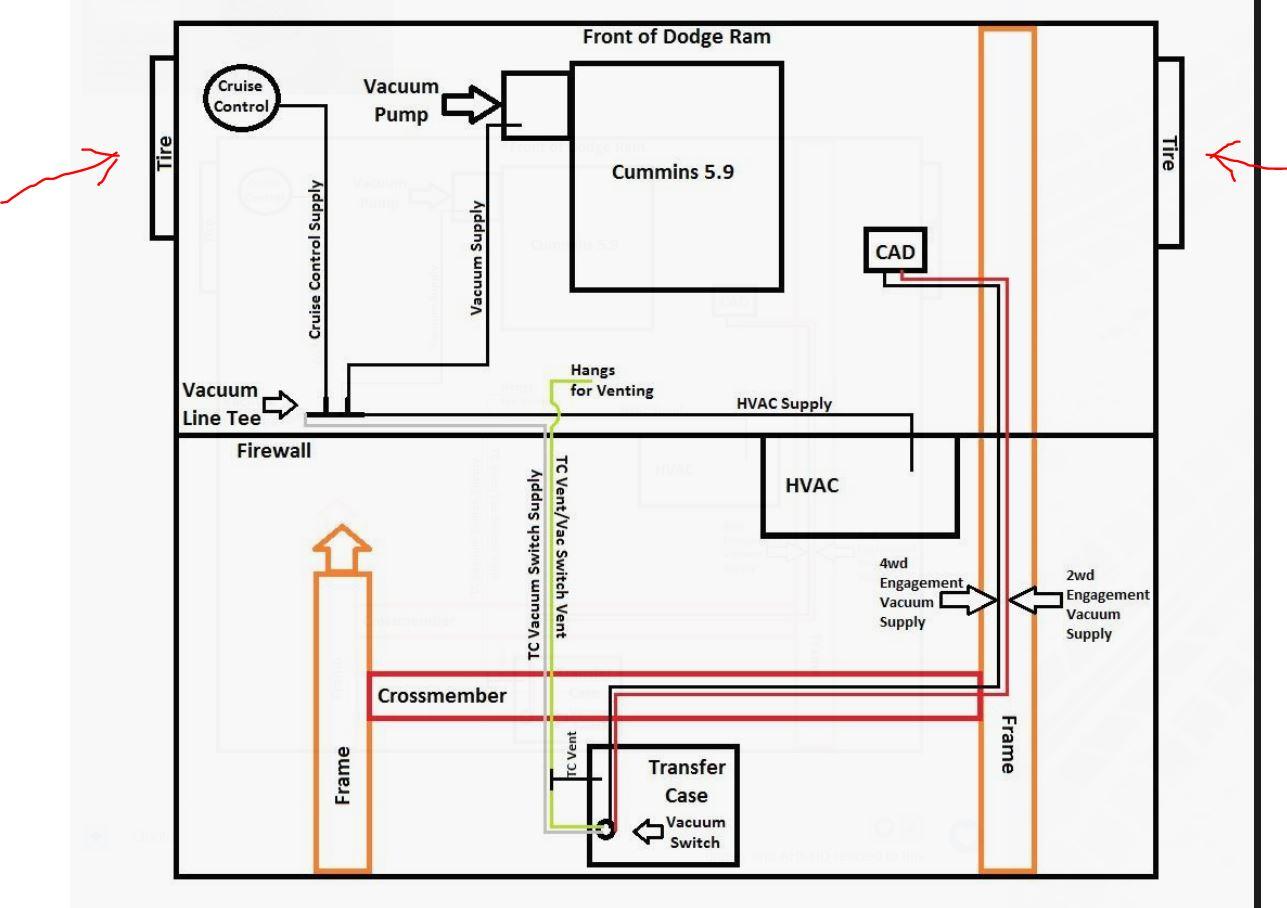
@Haggar, great post! However I do question the accuracy of the diagram. On my truck the front tires are farther back. @Mopar1973Man, I recommend that you turn off your vacuum operated wipers when you are going uphill. Ok, serious now, my '02 truck is an October 2001 (with CAD) and my brother-in-laws' '02 truck is a May 2002 build (no CAD). He was disappointed that I could not give him the 2WD Low Range function. @BDK, since you are having to redo all the CAD connections, this could be a good time to make your truck be able to have 2WD in Low range. Just putting it out there just in case it is something you want. On my truck I disconnected the lines to the transfer case and mounted a vacuum control valve in the cab that directly supplies vacuum to the CAD unit. - John
-
It sounds to me that you are describing the normal cycling operation of the intake manifold heaters . Combined, the two intake manifold heaters draw about 200 amps - that is why your are seeing the drop to 11 volts while idling. When the heaters cycle off, the voltage returns to around 14 volts. The heaters will continue to cycle until the engine coolant temperature rises to a specific value or when the truck has been driven over a specific speed - approximately 25 mph. - John
-
@MrMerica, thank you. It is all clear to me now. - John
-
I agree that there is a good chance there is a problem with sealing. But, headlight housings are manufactured with a vent, usually with a tiny screen covering the vent and usually located in a very inconspicuous place. So, it is possible for moisture to get in under some unusual wet conditions even if the headlight assembly is in good condition. If that is the case, drying the assemblies could be worthwhile. Doesn't cost anything but time. - John
-
You will need to park your truck in a dry garage for a few hours. Pick a day when humidity is low. Remove the bulbs and set up a fan to blow at an angle into headlight openings. The angle is important because some dry air needs to enter the headlight assembly, evaporate some moisture, and then exit the same hole. It will take a few hours, but it works. If the moisture returns right away, then the lens has a leak. I have used this procedure a couple of times and it works quite well. - John
-
Just be prepared mentally if your engine goes to 3 cylinder idle at thirty below zero. The first time (and only time) that mine went to 3 cylinder idle, I thought the engine threw a rod bearing from the racket it made. And that was at 18 degrees above zero. I make sure that I step on the brake pedal when I start the engine in cold weather. I use the exhaust brake for faster engine warmup. Much quieter. - John
-
Many people don't set park brakes. If you are one who does not set the park brake, you are likely to have your foot resting on the service brake pedal while you are starting the engine. That is will probably cancel the high idle feature. I found this out myself accidently. - John
-
Several years ago I had the same symptoms (brake lights staying on). I had read about the fact that you had only one chance at getting it right when installing a new one. So I took my old one apart and added a washer or two (can't remember) and re-installed it. It is the original brake light switch and is still working fine today. Sometimes technology seems to go backwards - why such complexity in a brake light switch? - John
-
Thank you for posting the fix for your problem, but I still am not clear on the solution. Did you replace the VP44 and some relays? or just relays. Also, which relays? Thank you, - John
-
@NorthernDodge, just be patient - you will probably get a reply from some knowledgeable people shortly. Do you have a wiring diagram available? If you do, you may be able to figure out which control module is being affected. Wiring diagrams can be a bit complex, but at least you have a good radio to listen to while you work on the problem. - John
-
I am another who has logged over 200,000 miles on front brake pads, rotors, and calipers. I replaced the pads and rotors at 215,000 miles just as a maintenance procedure - there was at least another 50,000 miles left on the pads. I am still running the original front calipers, now at 332,000 miles. And of course, I do have an exhaust brake and it gets used every time the truck is driven. - John
-
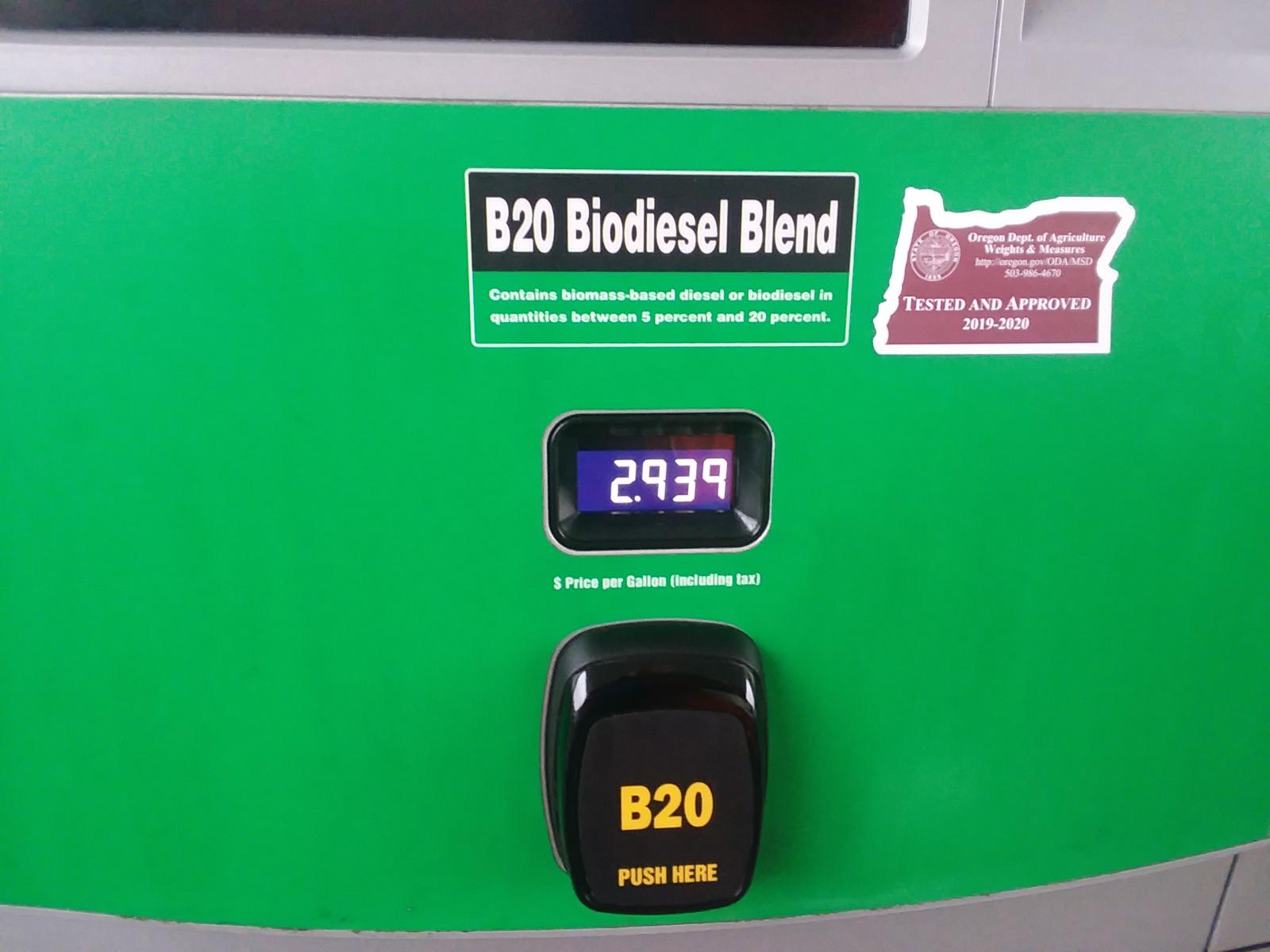
@dripley, finally, here is a photo of the label on the B20 diesel pump at Safeway in Molalla, Oregon. Now I have no idea whether the B20 in Oregon is bio-diesel or bio-mass based diesel, so since I have no idea of what I am getting, I think I will quit using the B20. - John -
-
My question (just curious) is: When you tested the bio-diesel from Ontario, Oregon and took a loss in mpg, was the fuel B5 (the mandated 5% bio-diesel) or was it B20? The reason I ask is because each time I use B20, which is about 30 cents / gal cheaper, I see an improvement in fuel economy. I have seen this mpg improvement over several trips during this last year. Also, @dripleysaid that he experienced an improvement in fuel economy when he used bio-mass diesel. These mpg improvements seem to defy the logic that there is less thermal energy in bio-diesel or bio-mass diesel, so what gives? Something that @dripleybrought to my attention - there is bio-diesel and there is bio-mass diesel. I am assuming that I it is bio-diesel that is sold here in Oregon, but I don't know that for a fact. I am still trying to find out. - John
-
It is always interesting to see such differences in fuel prices just a few miles apart. Prices for B5 diesel fuel is currently $3.32 /gal at three different stations in Baker City, just 70 miles north of Ontario. Price for B20 in John Day is $3.03 /gal, B5 - $3.40 /gal and for B20 at Safeway in Molalla, Or is $3.00 /gal and B5 - $3.40 /gal at other nearby stations. Safeway only sells B20. It is the B20 in both mentioned locations that is giving me improved fuel economy. You have to remember that I am making my comparisons from B5 diesel (mandated in Oregon) to B20 diesel. I will be monitoring the differences more closely in the future. Was the tested Biodiesel from Oregon B5 or B20? Have you ever tested B20? I think you are comparing Oregon mandated B5 diesel to Idaho regular diesel, so likely we are not making like comparisons being that regular diesel anywhere in Oregon is B5. - John
-
@Dieselfuture is right on here. Vacuum leaks are easy to overlook. The vacuum pumps are strong on these trucks and can easily overcome a significant leak and the leak will go by unnoticed. Even the HVAC controls will still work. Remember any air that leaks into a vacuum line will discharge that same air into the crankcase via the vacuum pump outlet. @Evan, my truck has about the same miles as yours and two times now I had noticed excessive vapors coming from the crankcase vent and both time it was caused from vacuum leaks. - John
-
This bio-diesel or bio-mass diesel thing is bugging me. I carefully looked over the sticker today at one of the diesel pumps here in Oregon. All it says is either B5 or B20, so I don't know if it is bio or bio-mass. @dripley, Do you know of any way to get that information? All I do know is that when I use B20, my fuel mileage increases despite the assumed fewer BTU's. I have used B20 several times now and each time fuel economy is very good - towing or empty. - John