
IBMobile
Staff
-
Joined
-
Last visited
Everything posted by IBMobile
-
STANDARD PROCEDURE - REFRIGERANT OIL LEVEL When an air conditioning system is assembled at the factory, all components except the compressor are refrigerant oil free. After the refrigerant system has been charged and operated, the refrigerant oil in the compressor is dispersed throughout the refrigerant system. The accumulator, evaporator, condenser, and compressor will each retain a significant amount of the needed refrigerant oil. It is important to have the correct amount of oil in the refrigerant system. This ensures proper lubrication of the compressor. Too little oil will result in damage to the compressor. Too much oil will reduce .the cooling capacity of the air conditioning system. It will not be necessary to check the oil level in the compressor or to add oil, unless there has been an oil loss. An oil loss may occur due to a rupture or leak from a refrigerant line, a connector fitting, a component, or a component seal. If a leak occurs, add 30 milliliters (1 fluid ounce) of refrigerant oil to the refrigerant system after the repair has been made. Refrigerant oil loss will be evident at the leak point by the presence of a wet, shiny surface around the leak. Refrigerant oil must be added when a accumulator, evaporator coil, or condenser are replaced. See the Refrigerant Oil Capacities chart. When a compressor is replaced, the refrigerant oil must be drained from the old compressor and measured. Drain all of the refrigerant oil from the new compressor, then fill the new compressor with the same amount of refrigerant oil that was drained out of the old compressor. Refrigerant Oil Capacities A/C System 210ml 6.2oz Accumulator 60ml 2oz Condenser 30ml 1oz Evaporator 60ml 2oz Compressor drain and measure the oil from the old compressor - see text. The above is from the 2001 Dodge Ram service repair manual, section 24 Heating & Air Conditioning, subsection Plumbing, page 24-57. Draining the compressor then adding 7oz of oil to it might over fill the A/C system.
-
You my find this shot article on packing an RV helpful. http://www.rversonline.org/99ConfRVPacking.html
-
See if you can find a can of 134A that also has an oil charge in it. Sometimes I find them with 2oz of 134a and 2oz of PAG oil or a can with 11OZ of 134A , 2oz of PAG oil and seal conditioner. You might want something like this;http://www.autozone.com/a-c-charging-and-refrigerant-freon/r134a-refrigerant/quest-r-134a-plus-refrigerant-not-for-hybrid-vehicles-with-electrical-driven-compressors/233038_0_0/?checkfit=true Remember that a 12oz can is equal to ¾ of a pound so 3 cans will give you 2.25 lb. It is better to under fill a system than to over fill it though you want to get as close to the volume required as possible.
-
You may want to replace the accumulator. It separators the oil from the 134A and it also has a desiccant bag for absorbing moisture in the system. If the system has been opened for any length of time the desiccant bag is saturated. This will allow the unabsorbed moisture the possibility of freezing at the expansion valve and causing a blockage in the system and no cool is the result. Yes, you need to replace the oil that is lost when you change a component. The evaporator take 2oz of PAG oil and another 2oz if you do the accumulator. When changing any component you'll want to replace the O-rings for the fittings. Before charging the system you'll want to use the vacuum pump to draw the system into a vacuum. This will not only remove the air that's in there but also, and the main reason, remove moisture.
-
The only way to really know what's going on in the Steering/hydro boost system is to put a pressure gauge on the pump and see what the pressures are when in operation. This video may help. https://www.youtube.com/watch?v=h9rgkZ_R-Mc
-
Face south, stay still, now moss can grow on your back side.
-
1. From U. S. Department of Energy: Alternative Fuels Data Center: http://www.afdc.energy.gov/fuels/biodiesel_blends.html "Pure biodiesel (B100) contains about 8% less energy per gallon than petroleum diesel. For B20, this translates to a 1% to 2% difference, but most B20 users report no noticeable difference in performance or fuel economy." 2. From U.S. Department of Energy: National Renewable Energy Laboratory: 100,000-Mile Evaluation of Buses Operated on Biodiesel Blend (20): http://www.nrel.gov/docs/fy07osti/40128.pdf "The fuel economy for both petroleum diesel and B20 groups was 4.41 mpg based on in-use fleet data. An approximately 2% reduction in fuel economy for B20 was measured in laboratory emission testing." 3. From Pacific Biodiesel: http://www.biodiesel.com/biodiesel/benefits/ "I want my MPG! Many alternative fuels have difficulty gaining acceptance because they do not provide similar performance to their petroleum counterparts. Pure biodiesel and biodiesel blended with petroleum diesel fuel provide very similar horsepower, torque, and fuel mileage compared to petroleum diesel fuel. In its pure form, typical biodiesel will have an energy content 5%-10% lower than typical petroleum diesel. However it should be noted that petroleum diesel fuel energy content can vary as much as 15% from one supplier to the next. The lower energy content of biodiesel translates into slightly reduced performance when biodiesel is used in 100% form, although users typically report little noticeable change in mileage or performance. When blended with petroleum diesel at B20 levels, there is less than 2% change in fuel energy content, with users typically reporting no noticeable change in mileage or economy. Superior Lubrication for Your Engine The injection system of many diesel engines relies on the fuel to lubricate its parts. The degree to which fuel provides proper lubrication is its lubricity. Low lubricity petroleum diesel fuel can cause premature failure of injection system components and decreased performance. Biodiesel provides excellent lubricity to the fuel injection system. Recently, with the introduction of low sulfur and ultra low sulfur diesel fuel, many of the compounds which previously provided lubricating properties to petrodiesel fuel have been removed. By blending biodiesel in amounts as little as 5%, the lubricity of ultra low sulfur diesel can be dramatically improved, and the life of an engine’s fuel injection system extended" 4. From GAS2: http://gas2.org/2008/04/10/biodiesel-mythbuster-20-twenty-two-biodiesel-myths-dispelled/#myth7 "FACT: Biodiesel contains about 8.5% less energy per gallon than petroleum diesel. For someone using B20, this means about a 1-2% loss in power, torque, and fuel efficiency. To put things into perspective, that’s about a 2 mph difference on the freeway if you were trying to go 55 mph. Millions of miles of onroad tests (aka trucking) have shown that B20 and diesel are practically indistinguishable. Biodiesel has also been used extensively in heavy-machinery, like tractors, loaders, and agricultural equipment, with no noticeable difference. B100 users may notice a slight drop in fuel mileage based on the small difference in energy content, but torque and power are usually comparable. I’ve seen a 1-3 mpg drop in fuel efficiency running B100. As an FYI, biodiesel has the highest BTU (energy) content of any alternative fuel (falling somewhere between diesel #1 and #2). Energy content of various fuels (per gallon, low value of range):" Regular Diesel Fuel = 128,500 BTUs Gasoline = 125,071 BTUs Biodiesel = 118,296 BTUs Ethanol = 76,000 BTUs In conclusion: in real world testing there is no noticeable change in power or fuel usage with fuel blends of B5 (5% bio-95% petroleum) to B20 (20% bio-80% petroleum). B100 (100% biodiesel did show a decrease in performance and fuel economy due to it's lower BTU value. The added benefit of increased fuel lubricity over the ULS fuel is a plus for the consumer in the form of possible lower maintenance/repair costs
-
Right you are! You too get a cupie doll. Driply's giving them out.
-
I see power steering fluid coolers on all types of vehicles. It can't hurt . I know that the power steering high pressure line right after the p/s pump can get so hot that I've gotten 2ed degree burns from leaning on it. check out these kits http://www.amazon.com/s/ref=nb_sb_ss_i_2_21?url=search-alias%3Dautomotive&field-keywords=power+steering+cooler+kit&sprefix=power+steering+cooler%2Cautomotive%2C216
-
Don't need a cupie doll. I married one.
-
After doing a little research in Diesel V Biodiesel I found that test results showed B5 fuel had a slight increase in fuel mileage and B20 was comparable to #2 diesel. Biodiesel also has an increase in it's lubricity rate. If you can get it for less use it. http://www.crimsonrenewable.com/mythvfacts.php http://www.consumerreports.org/cro/2012/05/diesel-vs-biodiesel-vs-vegetable-oil/index.htm
-
I ohm checked my battery temp sensor as well as my grid heaters. The ambient air temp was 68° F. the BTS was 11,830Ω with one of my meters and 11,930Ω with another (harbor freight free-be). The grid heaters were checked by ohm testing from the positive post of one heater at a time to the common ground. the readings I recorded were 36Ω for the + post closest to the valve cover and 26Ω for the other one.
-
I don't have 4 wheel drive but is there a lube point for the CAD that may need a squirt or two off something?
-
I think with that battery ground being loose you were running mainly on the left battery. Think of all the other thing that get grounded to that battery/battery cable. Doesn't the PCM ground there?
-
Rock stuck in tire tread let loose? Something thrown at the truck? Someone trying to get out of the truck bed?
-
Testing a BTS 99 Dodge Ram https://www.youtube.com/watch?v=KIuWfd_2LmY
-
That's a problem for the hearing impaired, like me. A friend of mine has a Snap-On torque wrench that does not only ft-lb, n-m, but also torque to yield angle degrees with an audible tone when the set limit is reached.. .
-
That black stuff on your fingers is the rubber that disintegrating due to old age. It's best to replace all those connectors.
-
Will work for coffee Have mug Will travel
-
I grew up believing diesels were suppose to be loud, stinky, and smoky. KISS always worked for me. I'm wondering what the repair cost/mile after say 300k, and 500k miles for two trucks of similar capabilities from different years. Compare a same manufacture's pre ECM, EGR, DEF, DPF, etc. truck to say a 2012-2014 truck with costs adjusted for inflation to one from 1980. With the added system/subsystems I'm sure we'd to a substantial increase in maintenance and repair costs. When I started working on cars in the early 70's a tune-up was replace spark plugs, points and condenser, check and clean distributor cap and rotor, adjust point gap (dwell), ignition timing, carburetor fuel mixture and idle at a labor time of 1hour @ $12/hr (dealer labor rate 1974) or $61.32 in 2016 dollars. One dollar in 1974 equals $5.11 in 2016. Now there is no such thing as a tune-up any more. There are no points, condenser, ignition distributor cap or rotor, and no adjustments allowed. To replace spark plugs on a turbo charged 5 cylinder Volvo is 1.4 hours @ $130/hr = $182 (dealer labor rate) that's a 297% increase to service the primary/secondary ignition system of a pre ECM vehicle. The maintenance costs are already known by the manufacture and are used by the marketing department in presentations for fleet sales. The manufacturer oil change intervals were extended from every 5,000 mi to 7,500mi so that the cost of oil changes over the life of the fleet is reduced by 50%. that's a big savings to the maintenance cost to the company but the repair cost will increase because of accelerated wear due to oil degradation. I've seen this happen in 1984. By the time the vehicles were reaching about 80,000 mi the cam shaft in the cylinder head was seizing due to sludge blocking the oil galilees. The manufactures don't seem to care about difficulty or cost of repairs, only that the Corporate Average Fuel Economy (CAFE) Standards are up and the EPA emission numbers are down, their vehicles are sold and it stays that way until the warranty is up. This is the price we pay for clean air.
-
Great to hear that it was a quick success and thanks for the pics. Some times you have to go with what works.
-
You can start with this You-Tube video https://www.youtube.com/watch?v=7Pk3u2rDF7s
-
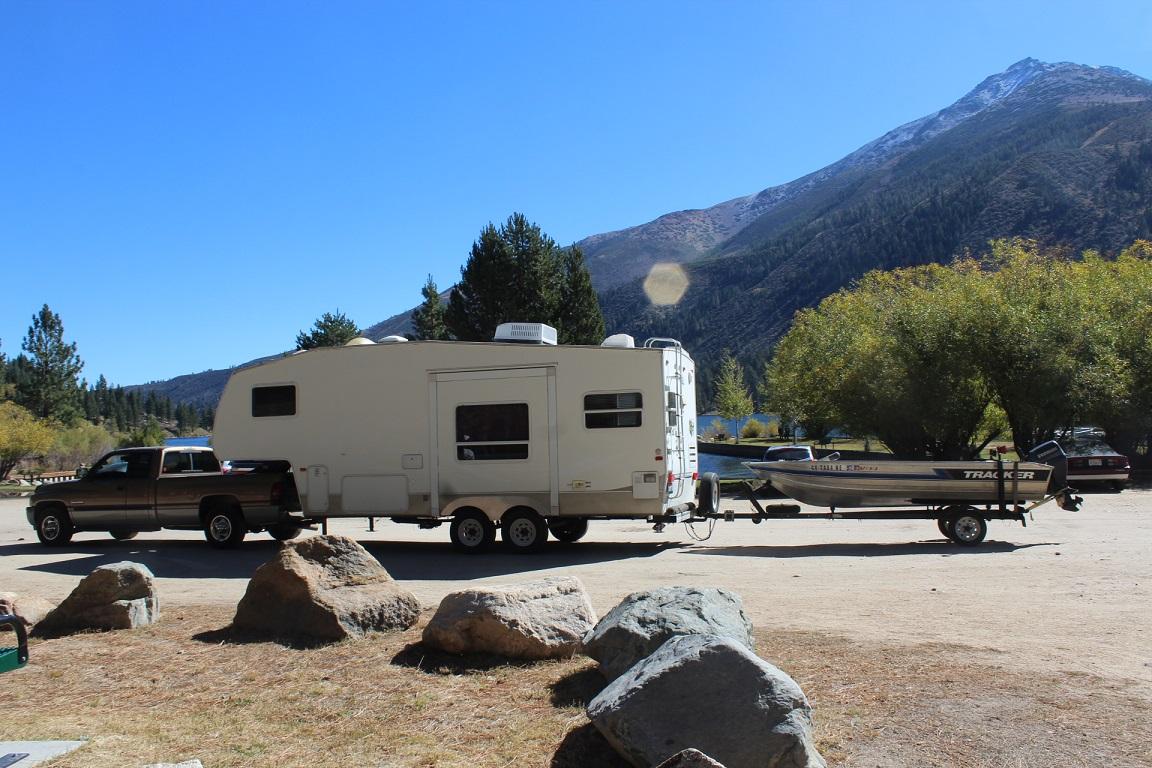
I had a small tear in the roof membrane at the front right corner of the 5er. Eternabond with a bead of Dacor non-sag lap sealant on the edges was used to seal it. I check it once a year and it's held up for about 6 years now.
-
The sad thing is the children are so young that this is their normal and know of nothing better.
-
Which model of the Progressive Dynamics 9200 series would you recommend?