
Mopar1973Man
Owner
-
Joined
-
Last visited
Everything posted by Mopar1973Man
-
No. There is no sign of the Quadzilla during smog checks (electronically) but if the inspector does a physical look then he'll see the Quadzilla some I've heard in Cally have modified the wiring and hid the Quadzilla in the cab.
-
Because the 3 FASS fuel systems that I sold locally all have issues with gelling up and having the filters struck in off-road conditions. Last one I sold gelled every winter. The guy got so pissed off at the FASS pump and the truck he sold the truck. Every winter New Meadows is subzero like -20F to -30F every winter. Typically the water and slush gets in the motor locking it up or it gelled up tight. These are all installed according to FASS instructions. What is better yet both running the same fuel from the same fuel station. FASS gelled up and the AirDog kept going. My truck has NEVER gelled once. Even working beside a FASS doing the same work that FASS would gel up and I was towing him home. That why. The other two pump end up being replaced because the fact of the filters being struck by off road usage where the filter hang below the frame rails. Once the filter are damage prime is lost and the truck is sitting dead.
-
My last AirDog failure I was at zero fuel pressure (rotor locked fuse blew) and capable of driving city streets no problem with a completely dead lift pump. Still had it towed home to not damage the VP44. VP44 FAILURES #1 - 48k miles P0216 code fuel pressure at 8 PSI #2 - 243k miles P0216 code and good fuel pressure 17 PSI #3 - Currently running.
-
I've got a cable builder in Caldwell the build our cables. I don't have any part numbers being its a finished cable when I get them.
-
Don't rely on the the internal vane pump. Not a sizeable volume pump.
-
What is your fuel pressure? (Idle and WOT at highway speed) Fuel pressure should be 14 to 20 PSI for optimal performance. Below 14 PSI the overflow valve closes cooling and lubing stops. P0380 or p0382 are grid heater failures. Check the small wires for damage or disconnected. If nothing found then the solenoids should be replaced. There is a open circuit on the small wire side typically.
-
MPG actually retards the timing in the winter. When the IAT goes below 80*F the ECM jumps up like 4* add degrees of timing advancement.
-
Most people get the rebuild kit from Pirate Jacks and rebuild the hydroboost unit. https://piratejack.net/hydro-boost-rebuild-kits/
-
Southern Idaho, I tend to keep the tank above 1/2 tank. That area down there is known for high winds. My last trip from Ontario pushed on me sideways all the way home. Really sucked for MPG performance like 18.38 MPG. High wind gusts. Now starting my morning at 19*F and breezy at 3 to 10 MPH and at least 1 inch of snow. Ugh.
-
No scan tool can read the MAP sensor correctly. Mine reports 28.3 at 2,800 feet for 2001 MAP sensor. Mine will max out at 37.3 PSI
-
Yup. The Quad can remain hooked up during a Smarty or TSB flash for high idle. Being the Quadzilla has ZERO connection to the CCD network or the SCI network which does the actual flashing.
-
I would avoid that kit that is just me though. Quick connectors tend to always leak air. Then having the the stock draw straw used is too restrictive for a 165 pump period. Then if your using the stock backet your returning hot fuel to the pump to pick up first. Should have its own draw straw away from returned fuel from either the pump or the engine. Should be all 1/2 hose from straw to engine. Should KEEP the stock filter. Doubled filter is optimal and the fuel heater helps a bunch for winter. (+19*F here this morning). FASS pumps because of the large size are more prone to gelling issues. (Which my AirDog never had an issues with all the way to -40*F)
-
Might try DAP we had some there.
-
150 Amp circuit breaker it is mounted on the firewall side of the battery tray away from the heat of the radiator. This will stop false tripping. Fuse should be installed closest to the PCM plug on the blue wire. 5 amp max fuse.
-
P1689 is a communication problem between ECM and VP44. There is a CANBus + and - leads. You need to ohm from end to end should result in <5 ohm, over 5 ohm signal is degrading. Then same wire to ground this should result in infinite ohms. Short to ground is bad.When damaged or weeping. 398k miles still on the OEM plug seal.Better than being a dumb ...Time to talk to @Dynamic...Not really. Just need a good sense of touch. Just like installing injectors.Personally I don't like the straw in the basket. There is the the thought of 1/2 or lower your keeping all the hot return fuel in the basket and very little cooling. Where the AirDog returns to the filler neck, the engine returns to the basket and the draw straw is no where near either. Hottest fuel temp I see typically is 135 to 140*F barely. Typically my IAT and Fuel Temp match. Being I've got 243k miles on the last VP44 not a bad setup. Fuel pressure: 14 to 20 PSI Dual fuel filters: 3 um on the AirDog, 7um in the stock can. Fuel temp: <140*F Wire tapped, 7 x 0.010 @ 320 bar Injectors.No. It will fail. The measurement has to be done on a empty tank. This will be the shortest distance to the tip. Diesel weighs 6.1 pounds per gallon which is 213 pounds of fuel. This will deflect the tank bottom downward giving more gap. As the fuel is consumed the tank bottom tightens to the tip allowing to draw all the fuel from the the tank. Large notches or making too much gap gives 1/4 tank issues... Tip needs to be tight to the bottom which getting empty to get all the fuel. One quarter coin gap, 1/16 notches... Less than 1 gallon left in the tank. Notice the notch still under the fuel.
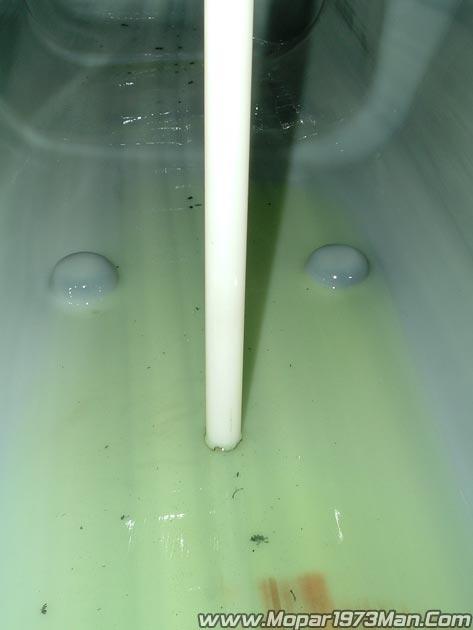 Should come as a complete kit. Follow the directions on the straw and cutting. Do not customize or change the cut for performance. The tip should be as close to the tank bottom as possible. FASS suggest stacking two quarters on the bottom and that is your gap. I'm running on a SINGLE quarter gap for the all this time.I tend to agree. There is no reason for over kill cable sizes. The stock size is going to be just fine too. If your worried about it then consider doing the the voltage drop test on the main cables and see if the cable is dropping more than 0.2 volts over the run. If it is I would replace the entire cable and maybe increase one gauge size.