
Mopar1973Man
Owner
-
Joined
-
Last visited
Everything posted by Mopar1973Man
-
Check your alternator before replacing the VP44. I would hate to see you ruin another VP44 with a bad alternator and possible AC noise issue.
-
Ummm... No pain, What you talkin' about Willis...
-
Ok. First off the ABS module is reporting ABS and BRAKE light. This is a speed sensor error. There is 3 speed sensors 2 sensors in the front axle and 1 sensor in the rear axle. There is a mismatch of speed between the 3 sensors. All 3 sensors MUST report the same speed or the ABS and BRAKE lights are turned on. As for the ABS module it will broadcast it speed signal on the CCD network. Any module that is listening can receive speed information from the ABS module. ECM uses the speed signal for cancelling grid heaters. PCM uses speed signal for cruise control and transmission information. The gauge cluster uses it for the speedometer. Now if there is a CCD network error P1698 or P1694 then the information is not getting to either the ECM or PCM. The gauge cluster might still function find because it just listens for speed signal. Just for information purpose the PCM is the master computer that creates the CCD network and the gauge cluster is what sets the voltage bias for the CCD network. If there is a P1698 or P1694 code then either the ECM or PCM is not hearing the CCD network.
-
Should of been 2 cycle oil. DieselKleen doesn't have any lubricant.Still there is a speed signal error. truthfully there is no real path of the speed signal. This why the CCD bus is different. The ABS just broadcasts the speed signal for any computer that is listening. So the ECM, PCM and Cluster all listen when ABS announces. Now if there is a CCD Bus issue like a P1698 or P1694 code that signal is not getting to the PCM or ECM. Gauge Cluster is a separate module and also controls the bus bias voltage for the CCD bus.All the products I've used typically already comes as a pre-measured dose. Unless you happen to use gear oil with the additive already.Still don't think its going to streetable. Like a 62/65/12 is a common good turbo. Stock is 54/60/12 HX35W.I think that turbo is just plain too big for use as a single. 71mm compressor, 71mm turbine with a 15cm2 exhuast housing its going to a hard to spool. 7 x 0.010 injectors are way too small. I'm running a HX35/40 hybrid (60/60/12) with no issues on 7 x 0.010 injectors. With the 285's tires and 3.55 gears will make it lag even more.Yes. Without tach signal there is no way for the ECM to detect if the crank even moved. The cam sensor is only a single tooth TDC sensor. The starter bump looks for lack of movement or lack of engine starting to see if the prime cycle is to used. CCD network issue. Quadzilla is directly hooked to the CANBus of the ECM. The Cluster is hooked to the CCD network so if the ECM isn't talking on the CCD Bus then the cluster doesn't read anything.No. Being once the Quadzilla comes online past the warm-up mode all IAT signal is igonred at this point. I'm trying to figure out a math to be use for the Quadzilla so we can bring back the IAT. Right now its a pain to constantly check IAT vs current timing and see if it need more retard and the IAT warms up. Then as the days cool off how much advance. Like starting back at about 20 to 30°F IAT it was +7° cruise timing. Now with 110 to 120°F IAT it is only +4° cruise timing. The base timing you can leave alone.Low PSI Timing Reduct: 3 Timing Reduct Scaling: 100 Change those two settings to... Low PSI Timing Reduct: 5 Timing Reduct Scaling: 100 That will toss a good amount of retard in launch from the hole. That will pull 5 degrees worth of retard for all 100% of throttle range while in low boost state then flip back to load based timing. Once he gets the timing figured out then you can bump the fuel up more. Like I'm running... 17, 20, 23, 26, 27 for timing. But remember I'm high in the pop pressure so this give you a bench mark for how far I've went but you'll most likely be below me.Everything I've done is based on test data and making sound judgement calls on parts. My budget is a extremely tight and poor choices can result in wasted money.Praise the Lord. I've completed my 3rd and final bladder cancer surgery which last mere 40 minutes or so. I would like to say Thank You to Dr. Spencer and all the St. Luke's hospital staff for the care and comfort provided. Then I've got to Thank all my friend that schooled me in cannabis usage. Because of the cannabis I DO NOT require chemo or radiation treatments. Next check up is scheduled in October. At this time Mopar1973Man is cancer free. Thank you all that have donated to my medical expenses. As of June 10, 2019 at about 4pm I'm officially cancer-free. I won't see the doctor till some time in October. Time to celebrate...I'm running 7 x 0.010 150 HP and a HX35/40 hybrid turbo. No issues. Daily driver 1,000 miles a week and getting roughly 21 MPG.Should have trailer relay in the PDC. Even my 1996 Dodge has a trailer relay. But... If the trailer is not wired to that relay but the tail light wiring of the truck of course the headlight switch will get hot. This problem came from the 1st gen truck that had no trailer relay at all. But was resolved in 1994. Biggest problem is did any one modify wiring on the truck?I've been logging my fuel way back 20k miles. I've still got old spread sheets and my original fuel log book. This is how I figure out what mods and such produce the best gains.Need more cruise timing... 1 degree isn't enough. Bump it to 3 degrees and try again. Personally I think all the max timing needs +1 across the board.I will as soon as all the drugs clear out ill be surfing on my cellphone. Promise...Optimal IAT for daily driver is 100 to 140F. BHAF doesn't change IAT that much being the intercooler can only cool to the outside temp. Once the IAT falls below 80F there is a loss. I see this every day. Start at 32 to 35F in the morning by late morning when I hit Ontario I'm in the 70 to 80F temp range and creeping. Into 100 to 110F IAT and MPG rises quickly from there.Not asking anything more. You are @kzimmer.You need 40 warm up cycles to clear error codes. In a nutshell the coolant has to start below 140*F and then rise above 160*F. That is one warm up cycle. Then cool back down to below 140*F then rise again to above 160*F without tripping the code. It just easier to erase the codes go for a test drive and check after 10 to 15 mile drive if the code returned.Suggestion... https://www.simplyauto.app/ Helps with keeping good fuel logs.
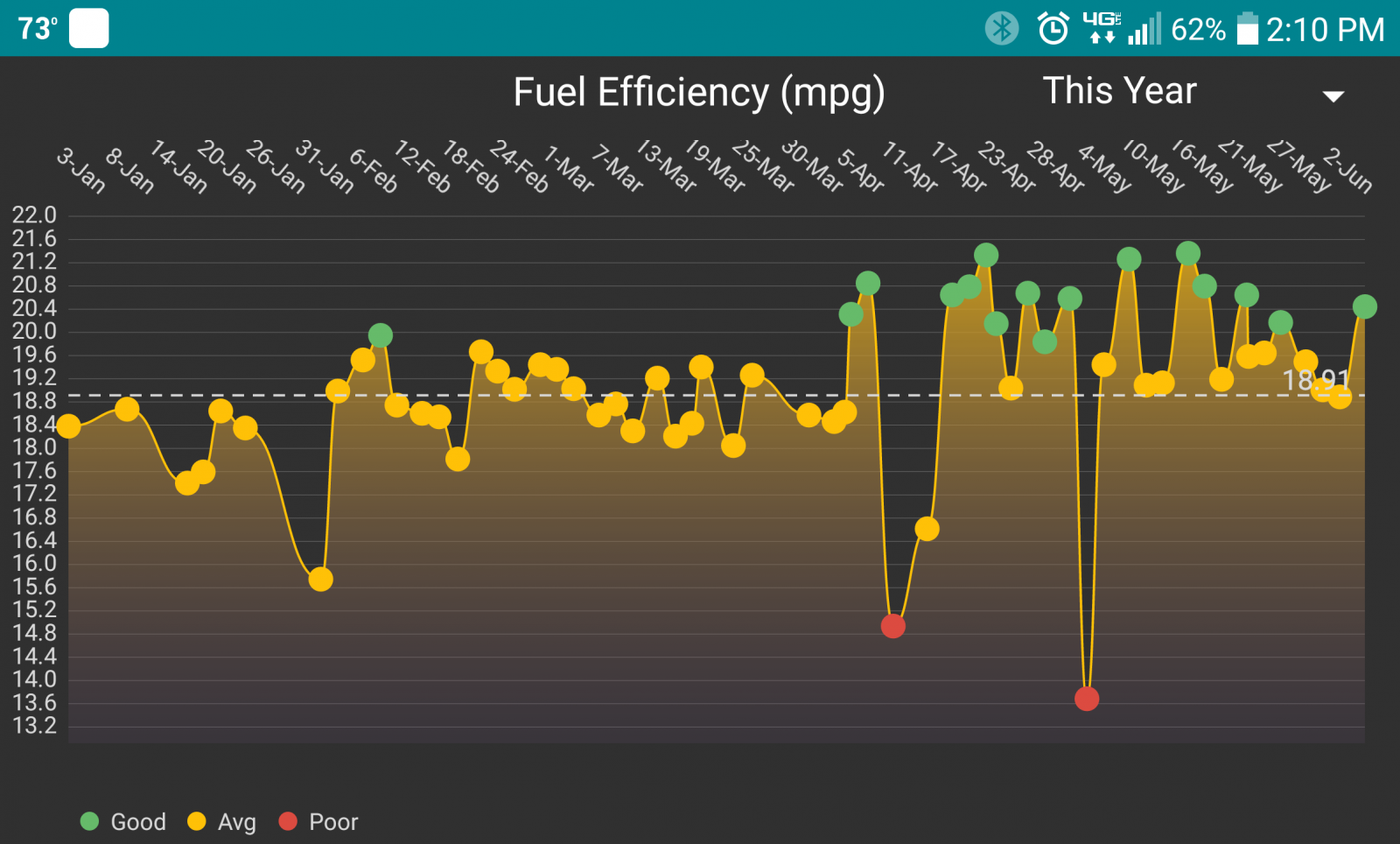 Upload your tune so I can look at it. I'm going to bet money the timing is set up wrong. With 6 x 0.013 injectors you going to need more timing typically but most miss the mark go either too retarded or overly advanced. The only way I found how to do timing right is keep a fuel log and run 2 to 3 tanks of fuel then make a small change in timing if you making gains in MPG keep going the same direction. Then test again. The better your timing is the lower the engine load will be. Typically economy and efficiency problems are more so timing than fuel map.I'm tired and I've tried everything I can... This is why I'm great at keeping logs of everything because when some one calls me out I can produce logs and information fairly quickly. Now not to sound like an but... This is what kind upsets me about this entire thread. Lots of hear say about all kind of stuff with nothing to back up anything... At least I can come forward with screenshots and fuel logs. Even created problems on my own truck to even match the OP problems. Which is beyond the call of duty. Tell me I'm using more fuel and nothing to back up the statement, no fuel logs, or trip data. I have little belief in the statements or what been said... Where I've already produced my fuel logs and 19.58 MPG test run. https://mopar1973man.com/topic/16243-egt’s/?do=findComment&comment=211135 Then I tried reproducing massive boost leak to see if I could even get close to the OP problem, Nope... https://mopar1973man.com/topic/16243-egt’s/?do=findComment&comment=211379 Then I posted EGT's were and I produced a screenshot of my Quadzilla running down the highway at 80 MPH https://mopar1973man.com/topic/16243-egt’s/?do=findComment&comment=211461 Then people saying I'm running smaller tires. Nope, Stock sized tires. Which I'm running the exact size on the door sticker. https://mopar1973man.com/topic/16243-egt’s/?do=findComment&comment=211425 So I've done my due diligence and provided all the information and data from start to end. Peace out, I'm done...