
Mopar1973Man
Owner
-
Joined
-
Last visited
Everything posted by Mopar1973Man
-
Well you could just use 2 valves one for the suction lines and the other for the return lines. Then both tanks would be usable. As for pumping from tank to another typically results in a mess. I seen so many times where a person does this and then ends up over filling the tank and pushing diesel out of the main tank all over the highway. Best to just hook up both and use the second tank first then flip back to the original tank as a second because it has a gauge. Or if you really slick change up the sender and hook both up on a toggle switch. My old 1972 Dodge had the behind the seat tank and then a aux tank under the bed. Just had a pull knob toggle switch that controlled the fuel valve and the fuel gauge. Same thing could be done on our truck just got to plumb the return line too.
-
I'll have to take a peek at mine... I pulled a lot of heavy logs and trailers...
-
Also running Timbo's APPS and still have a slight bounce to the tach. Nothing that bothers me so far. Now if we start talking about my injector misfire different story. (Time to clean again!)
-
:lmao:I know the day that Smarty does release that there will be new life back to the VP44 powered vehicles. But I still wonder how much they really can do with it.
-
The only thing to be aware of if your doing any offroad service even plowed roads I would highly suggest you reconsider your mounting because any pump mounted flat to the frame rail will be beat up from all road debris thrown by the front tires. So consider you mounting location wisely.
-
I did the AirDog 150 years ago to just get over the hurdle of fighting fuel pressure all the time. Completely protected by the skid plate and transfer case. I tend to go offroad to get firewood in the fall of the year. Never had any problems with this setup.
-
I'm running yellow now. As for mileage I put 30K miles on every year just about. Then looking in the owners manual that is the period when all fluids should be changed. Heck with all the running for SAR's I've cleared 1,000 miles in 4 days. So roughly at that rate 120 days I would be changing fluids again. Thank Gawd I'm not though...
-
Lately... I don't sleep very much being that I've got night duty on the fire. As for the diagnostics yeah I would double check all wiring before buying parts and guessing.
-
For the last 4 days of working SAR's up on the Sheep Fire I've been buying $50 bucks of fuel every night at $4.299 and so far I just about cleared 1,000 miles of travel.
-
WalMart SuperTech Coolant and Prestone are both YELLOW. As far as I understand yellow is universal and can be used with either green or orange.
-
You might want to look up the codes over here for correct definition and diagnostics. http://articles.mopar1973man.com/2nd-generation-24v-dodge-cummins/59-obdii-error-codes P1689 http://articles.mopar1973man.com/2nd-generation-24v-dodge-cummins/59-obdii-error-codes/228-p1689-no-communication-between-ecm-and-vp44 P0336 http://articles.mopar1973man.com/2nd-generation-24v-dodge-cummins/59-obdii-error-codes/175-p0336-crankshaft-position-sensor-signal As for the lift pump yes its very possible the lift pump is shut down when the RPM's die out because of a failed crank sensor. Also the alternator dies out too.
-
But make sure you think it out before you randomly poke holes in the basket think about road conditions, slope, braking, acceleration, etc.
-
CajFlynn's RV275's worked good in his truck but randomly miss on my truck. I cleaned them up and now the miss is back again. I got to get free from the Sheep fire Security Duty to get my repairs done.
-
I've even consider that myself for the winter time... Just never did it.
-
Fuel filter is getting dirty on my truck my idle pressure is down to 18 PSi... WOT is slipped down to 16 PSI. Not worried yet.
-
Fuel sender float in the tank rotting away? Yes. I seen a few report that some fuels and fuel additives can do this.
-
The only time the adjust on the fly is really needed for me is heading up canyon in the dead of winter. I might start with clear roads and leave the Edge cranked up. Then when I get to the snow line I can adjust the power to keep grip. There is another problem with any flash type modules. After many, many flashes adjusting up and down constantly it will wear out the EPROM module in the ECM. I'm not sure of the count but its rather high. Where wired module doesn't have this issue.
-
Well I bit south of you and I get the cheap ol' WalMart and mix it 50/50 without a issue all the way down to -25*F and no problems in 10 years of ownership. I don't get wrapped up in claims of coolant performance. Oh yeah I'm pretty sure Prestone makes SuperTech Coolant like PennzOil makes SuperTech Engine Oil's.
-
Air Dog with quick connects are prone to suction air leaks. :rolleyes:Change you plumbing back to old school JIC and Pushloc's and most of the problems go away.
-
Dripley is right the whole unit has to be removed and bled hanging vertical to remove all air.
-
One of the few reason I will not buy a Edge Juice or Quadzilla Adrenaline because when the unit dies it takes everything with gauges and all now left blind for critical engine info. I rather always suggest gauges and separate module.
-
There is a restriction some where for sure. Old School AirDog 150.. Center gauge. As you see it get down to 15 maybe a bit lower but not much. 2-3 PSI fall is typically for mine. Now I'm set for 19 @ Idle and 17 @ WOT. Now on the return trip I suck air bubble pressure will fall out. http://www.youtube.com/watch?v=grl72Up-8T0
-
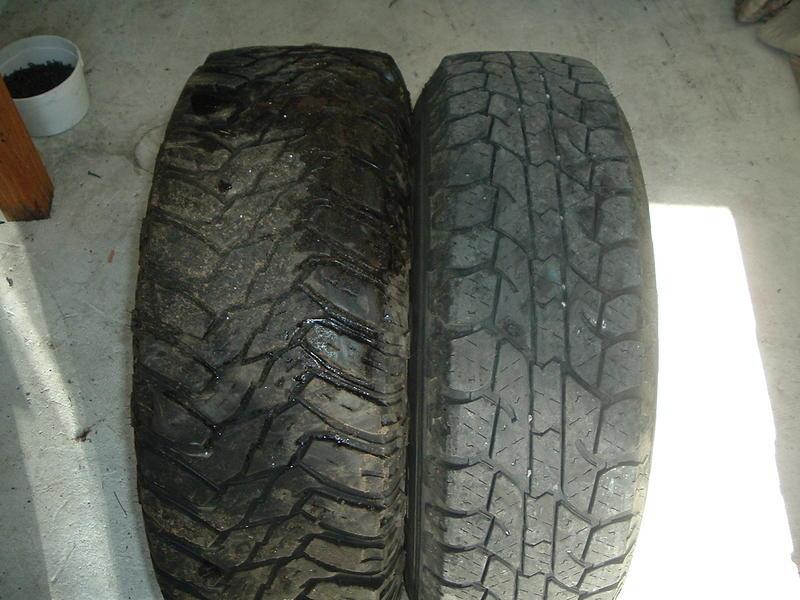
You could opt to change to 235/85 R16 and save a few buck on tires. They are the same size tire height wise but about 1.5 smaller in width. The attachment is 265's vs 235's...
-
203K miles on my trans and zero problem using solely the Mopar Trans fluid and changing every 100K miles. As for my clutch I broke the hub on my stock clutch at 150K miles. Now the South Bend Con OFE is holding good. As for mountain road travel I've got no issues with that. I can travel up and down just about any Idaho grade without using my service brakes. Like right now driving about 90-110 miles one way for SAR's duty in the middle of nowhere Idaho climbing mountain road. Even hauling firewood I've got no problems. http://www.youtube.com/watch?v=Vh7lOJLD948 http://www.youtube.com/watch?v=KDjMzmV4bbw http://www.youtube.com/watch?v=N0yjDv8Slkw
-
ScanGauge II...But as for you truck I'm going to assume you got a 2001 Dodge if so you'll need a code reader. I tend to like the ScanGauge II...